

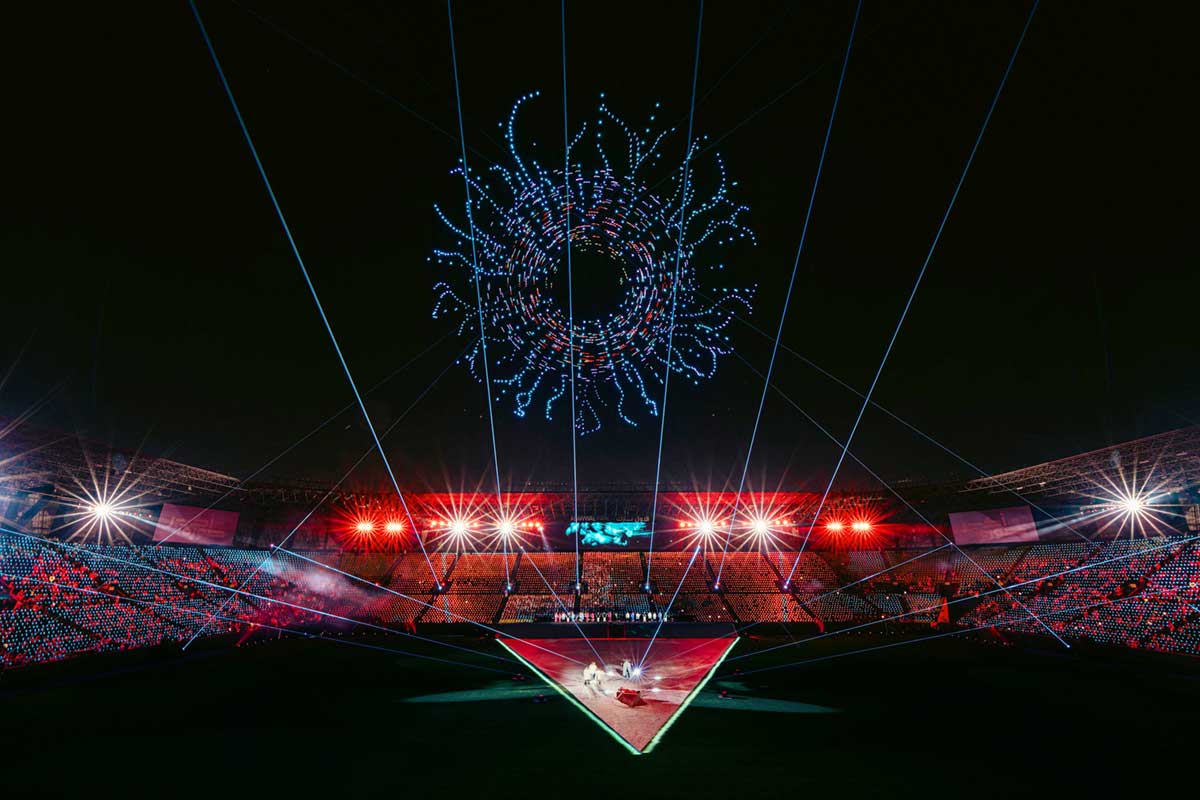
For large-scale ceremonies, the challenge has long been how to make audiences feel connected to a narrative unfolding hundreds of metres away. At Al Nassr Stadium in Riyadh, creative studio Dreamed by Us attempted to answer that question by transforming the audience itself into part of the scenography.
Commissioned by the Saudi Commission for Health Specialties and delivered by ADD Enterprise, the graduation ceremony brought together approximately 8,000 graduates in a production that blended live opera, projection, drones, lasers, audience lighting and immersive multimedia storytelling.
Rather than treating the crowd as passive spectators, the production team integrated them directly into the visual language of the show through Enjoy Technology’s wireless audience system, Enjoy Galaxy. The result was a technically ambitious stadium-scale experience in which the grandstands became a dynamic extension of the stage. “The ambition was to elevate the ceremony and reflect the significance of this milestone for the graduates, with the audience becoming part of the overall creative approach,” explained Show Designer and Show Director, Olivier Ferracci.
The production brought together several creative and technical partners, including: Lumasky (drones), Igual (fireworks), Lightab (lighting design), Love4lasers (laser design), Imvision (video content), DC (construction), and Spectrum (audio, video, lighting and lasers).
The production’s central concept revolved around the transition from student to healthcare professional. Olivier Ferracci and Scriptwriter and Stage Director, Nora Matthey de l’Endroit, conceived the show as what they described as one of the country’s first “opera rock multimedia” productions featuring fully live opera singers rather than pre-recorded vocals.
The narrative drew inspiration from the Hippocratic Oath, using theatrical storytelling to symbolise commitment, responsibility and service. However, translating such themes into a 25,000-seat stadium environment required a visual system capable of operating across multiple layers simultaneously.
“We wanted the audience to feel emotionally involved in the story, not just observe it,” the creative team explained. “When the idea of a virus was introduced, it was visualised as something spreading across the stadium, moving from the stage into the audience.”
To achieve this effect, audience lighting became more than decorative enhancement. Using thousands of wireless LED devices distributed throughout the stands, the production transformed spectators into what Ferracci described as a “living surface” capable of movement, colour transitions and visual continuity between the pitch and seating bowl.
“The entire production served to heighten the drama and emotions expressed by the various characters,” the team stated. “Turning the audience into a screen particularly helped us create continuity between the pitch and the stands, amplifying the feeling emanating from each actor while helping us establish a link with more aerial effects such as lighting, projection, audience light, lasers and drones.”
Unlike conventional LED walls, the “human pixel” approach introduced a very different set of technical parameters – resolution, refresh rate and brightness had to be recalibrated around the realities of human spacing and wireless communication rather than fixed display hardware.
“Technically, this involved applying filters to adapt the content to the resolution and refresh rate provided by the device,” Olivier noted. “Then came on-site adjustments to calibrate the various effects and sources relative to one another in order to achieve the smoothest possible continuity.”
The integration process demanded close collaboration between creative and technical teams from the earliest stages of pre-production. Storyboarding proved essential, allowing the production team to map the interaction between stage action, audience effects, projections and aerial elements before arriving on site.
“In our creative process we storyboard everything as part of a truly gradual process,” the team explained. “The theatrical background of Nora helps a lot in transforming emotion into graphical patterns.”
That workflow became especially important given the scale and density of multimedia elements involved. Beyond audience lighting, the production incorporated overhead screens, floor projections, live performers, drones and laser systems, all of which required careful balancing to avoid visual overload.
“Taking into consideration the scale of every tool from human to drones was essential in order to avoid each of them ruining the attention,” Olivier reflected. “It’s like a musical score where you have to know when to highlight the soloist, the choir or the entire ensemble. Each effect was treated as a protagonist in its own right.”
At the heart of the technical infrastructure was the challenge of maintaining synchronisation across approximately 25,000 wireless devices distributed throughout the stadium environment.
“Beyond the creative aspects, one of the key challenges was finding a visual balance between the different layers of the show,” the team explained. “Some elements naturally come with different brightness levels, so part of the process was adjusting and fine-tuning the intensity to make sure everything could sit together as one coherent image.”
Latency and responsiveness became critical considerations. In large-scale audience systems, even minor delays can break the illusion of continuity, particularly when content interacts directly with music, projections and stage choreography.
“Keeping everything responsive and in sync at that level was essential,” Olivier said. “It really depended on a system that could hold together reliably throughout the show.”
In traditional wired audience-display systems, cabling requirements can introduce major deployment challenges, particularly inside existing stadium infrastructure. However, the wireless nature of the system also significantly improved installation logistics and rehearsal efficiency.
“The wireless aspect had a very real impact in practical terms,” the team noted. “It made the installation much faster and more flexible. It also meant avoiding a lot of cabling and all the coordination that usually comes with it, which can easily slow things down on a project like this.”
That flexibility enabled the team to devote more rehearsal time to refining creative synchronisation rather than infrastructure management – an increasingly important advantage as live event productions continue growing in scale and complexity.
Dreamed by Us believes this shift reflects a broader evolution in audience-display technology. Historically associated with simple colour effects in ceremonies and opening shows, modern wireless systems now allow audiences to become active participants within narrative structures. “It’s a rapidly evolving field,” they observed. “Things have shifted over time from simple colour effects to content, then to interactivity, and now towards more fully live experiences.”
Importantly, the team sees the technology not as spectacle for spectacle’s sake, but as a storytelling tool capable of changing how audiences emotionally connect with large-scale productions. “You could feel a real sense of engagement and pride from the audience,” they recalled. “They were no longer just watching the show but becoming part of it.”
That audience integration also changes the perspective of other creative disciplines within live production. “It changes the way broadcast and lighting designers consider the crowd,” The duo stated. “Not just as spectators, but as part of the momentum.”
As stadium ceremonies continue embracing immersive technologies, projects such as the Al Nassr Stadium graduation ceremony demonstrate how wireless audience systems are evolving from visual enhancement into a fully-fledged storytelling medium. This production represented more than technical experimentation; it was an attempt to create emotional continuity between performer and spectator at scale.
For Dreamed by Us, the project ultimately became about, in Olivier’s words: “pride, passion, and satisfaction at having been able to bring such a sparkle to the eyes of all these people.”
Photos: Dreamed by Us