

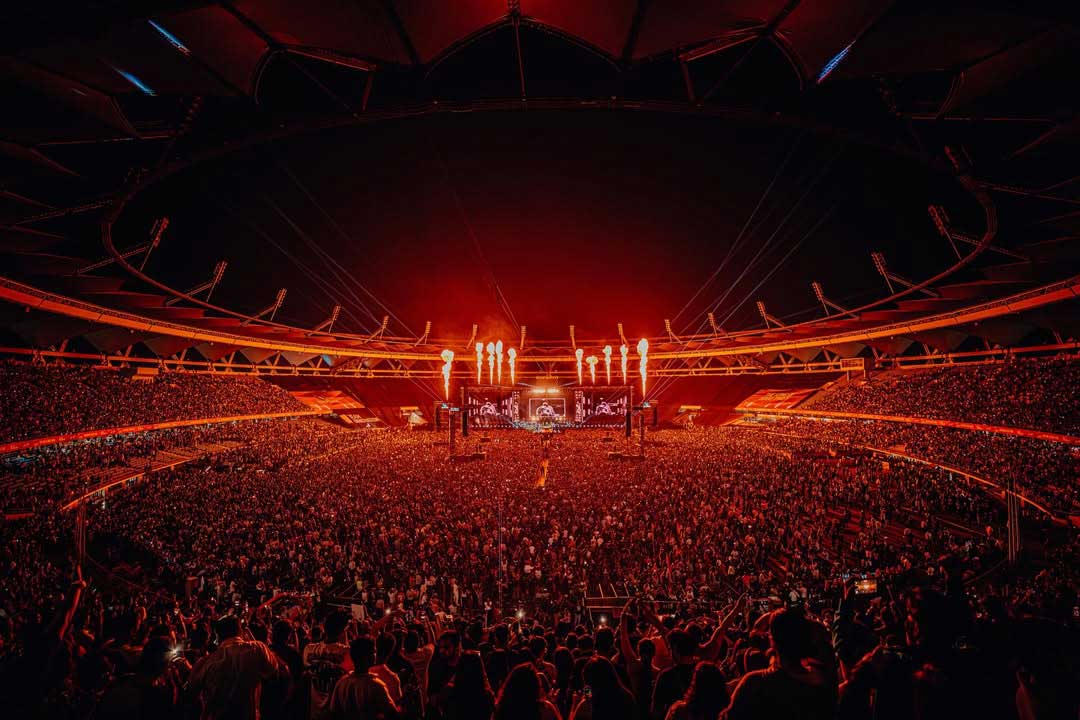
When Karan Aujla kicked off the India leg of his spectacular P-Pop Culture Tour in New Delhi, it was a show that set a new benchmark for live music in the country. Among its many achievements, the production featured India’s largest ever deployment of d&b audiotechnik inventory, specified for this leg of the tour by local rental company Hertz & Pixels and supplied by d&b’s local partner, Ansata.
One of the most popular artists in the Punjabi-speaking music world, Karan Aujla also provides an important connection to the wider music industry, with hits on the UK Asian chart and Global YouTube music chart. With Aujla drawing massive attention, the arrival of his P-Pop Culture Tour in India was as high profile as any performance has ever been in the region.
With a massive 75,000-strong audience in attendance at Delhi’s Jawaharlal Nehru Stadium, FOH Engineer O’Necean Gordon was aiming for consistency and control. “With a crowd of this size, it’s important to make sure the experience translates everywhere, and is consistent from show to show,” he explained. “I like to keep things clean and controlled, especially in the low end, so that it doesn’t become uneven across different zones. My approach was to really trust the system design and then mix into that.”
Gordon’s had at his disposal the largest d&b system to be fielded in the country to date. Consisting largely of SL-Series, it included 32 GSL cabinets making up the main system, supported by 20 flown SL-SUBs and 52 floor-standing SL-GSUBs, with more SL-Series – 96 KSL cabinets in total – providing outfills and delays. The system also included 16 AL90 augmented array boxes as front fills, and 12 V-Series as 270˚ stacked fills. The entire system, with the exception of the subs and fills, was optimised with d&b’s ArrayProcessing.
Neil Lean, Education and Application Support at d&b audiotechnik EMEA, who supported Hertz & Pixels and Ansata with the system design, explained that the needs of the system were multifaceted. “The goal in designing a system for a stadium isn’t only ‘how loud can it go?’ but ‘how even can the coverage be?’ and ‘what’s the best intelligibility that can be achieved?’. The challenge is to do this at a level that can be heard above the noise of 75,000-plus excited audience members,” he stated.
“With d&b’s ArrayProcessing, it’s easy to achieve consistent overlap between the mains, out-fills, delays and fills,” he added. “That accuracy helped immensely with the evolution of the design, from the planning phase to deployment.”
Gordon commented on the “solid foundation” offered by the d&b system, “before you even touch the console”. He noted: “The clarity and headroom mean you’re not fighting the PA, you’re working with it. That lets you focus more on the musicality of the mix rather than problem-solving.”
According to the FOH Engineer, what stood out was how predictable everything felt. “When I made a move, it translated the way I expected it to,” he reported. “That kind of consistency builds a lot of confidence – especially in a fast paced, high-pressure environment.”
Describing the support as “top tier,” Gordon praised the local suppliers as well as the manufacturer. “Ansata and d&b understood the assignment – that it’s not just about having great gear, it’s also about execution,” he commented. “Everything was dialed in, and communication was smooth throughout. Knowing those competent individuals were there made it very easy to focus on delivering. That kind of support makes a huge difference, especially on a production of this scale.”
Photos: Rapkar, Team Innovation