

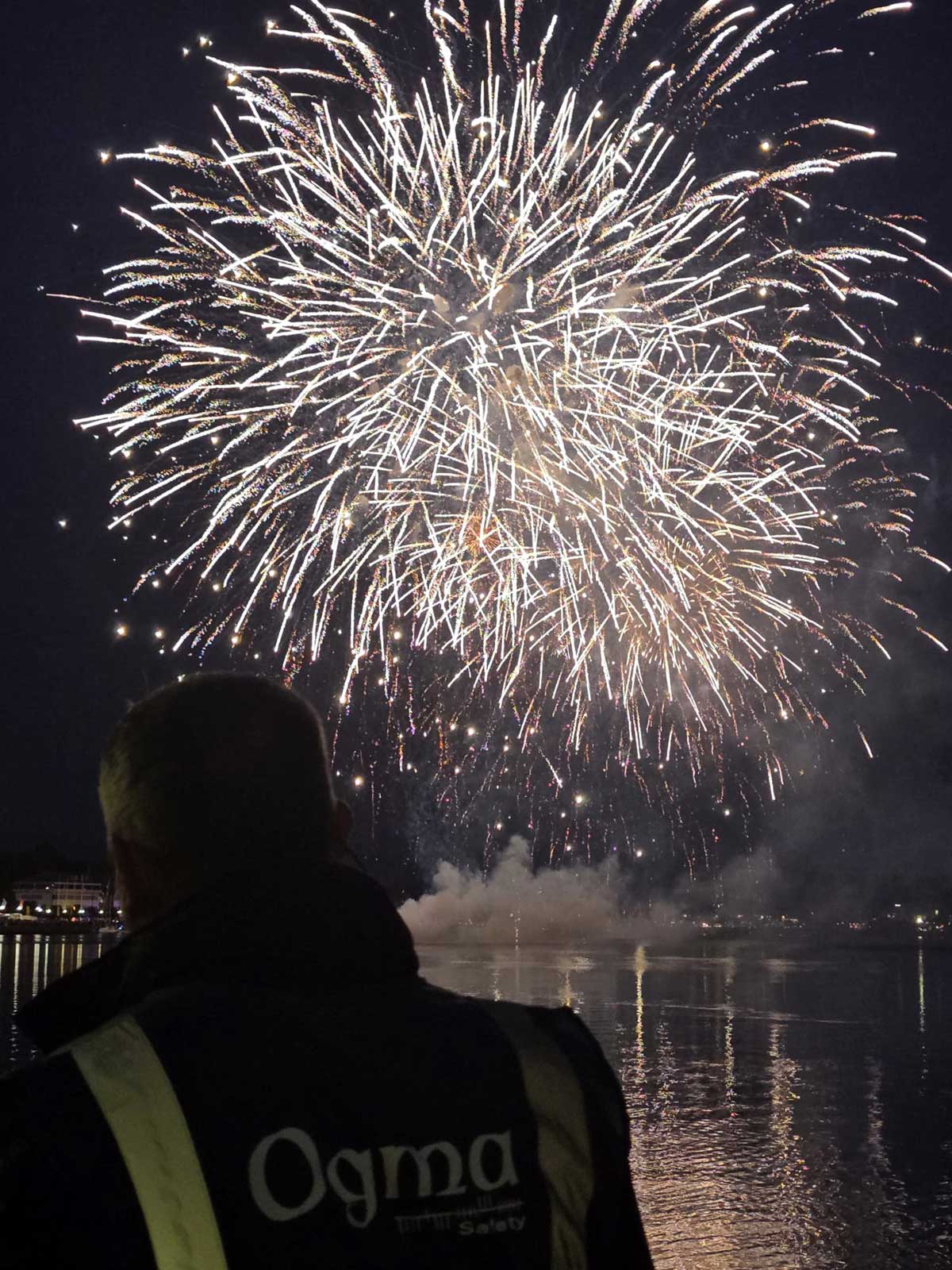
By their very nature, health and safety and crowd management tend to be disciplines within the live events industry that go largely unnoticed by many. Yet, extensive work is being done behind the scenes of all the biggest and best events in the region to ensure that the entire project, from load-in to live show to derig, runs smoothly, safely and without incident.
One company that has been a mainstay in this field over the past decade is Ogma Safety, having spent the past 10 years since its foundation in 2016 quietly building its reputation in both the Middle East and in Europe. “We’ve been operating in the Middle East and Europe supporting our clients on major events and exhibitions for years, but we have never really shouted about what we do until now,” stated Ogma Safety Director and co-founder, Declan Meenan, discussing the company’s expansion plans with TPiMEA. “However, we can see how much the Middle East market especially is growing, and we plan on growing with it.”
A former police officer, Meenan got his first taste of the live events world at just 16 years old, working alongside his father, who was Head of Security for Derry City Football Club at the time. “We come from all different backgrounds,” the co-founder said of the Ogma team. “While I come from a police background, we have former government advisors, construction safety, food safety, teachers… the wide range of experience within the team is a real asset to us.”
In fact, despite the recent challenging period for the Middle East, Ogma has continued with planned hiring activities, bringing in six new full-time staff. According to Meenan, this focus on building the Ogma team is proof of the company’s belief in the region. “It’s not just talk,” he commented. “We have made a deliberate bet on the momentum building across the Middle East’s live events landscape. Rather than taking a pause-and-wait approach, we decided to invest now in a team that is capable of supporting the company’s next phase of growth.”
Along with its growing full-time team, Ogma can also call upon a large pool of freelance talent based in the UAE as well as the wider Middle East and in Europe. “You won’t often see us needing to go on a major recruitment drive as we already have the relationships in place with trusted freelancers who are ready to jump onto projects,” he revealed, noting the example of a major international project taking place in August, which Ogma had 25 staff onboarded for within just 15 minutes of having the job confirmed. “We had flights and accommodation booked and the team ready to go,” he recalled.
Meenan believes that this ability to mobilise large teams at a moment’s notice is key to Ogma’s excellent record when it comes to client retention. “I’m extremely proud to say that we have never lost a client,” he beamed. “We often get calls from clients asking for specific people by name after working with them and being able to call on the same trusted people time after time is a massive value add that we’re able to bring.”
This loyalty is something that Meenan and the Ogma team do not take for granted, and there’s a genuine care given to ensuring that everyone is treated properly on any project that the company takes on. “When I arrived in the region around eight years ago, working long hours used to be worn as a badge of honour; if you hadn’t been awake for 24 hours during a job then people joked that you were working a half day,” he recalled. “We saw this change massively when Expo 2020 came in and put in place strict welfare conditions, and since then there’s been a real shift in how most people in the region now understand that the most successful events are delivered without the need for working crazy hours.”
Despite the clear progress made throughout the region since Expo 2020, Meenan still sees some areas where improvement is required. “My biggest area of concern is when you see the same crew who were on site from early in the morning during set-up still working through into the following night during derig,” he observed. “We all know that derig is most dangerous time – crew want to get out quickly and they are often fatigued after a long live day. This is where split shifts offer a significant improvement in terms of safety.”
As well as the need for safeguarding against fatigue, Meenan explained why the greatest step any event can take to ensuring safety is allowing enough time for planning. “If we are brought into a project in the initial stages, we can ensure that health and safety are baked into every aspect of the event,” he commented. “Most of our work happens long before we reach an event site, and we’re able to add so much more value if we are involved from the start.”
While the Ogma team is in the midst of a busy summer season handling several large-scale festivals and events for international clients, Meenan isn’t taking his eye off the ball when it comes to the Middle East. “Pretty much all the live shows that were scheduled to take place from the end of February up until the summer were rearranged for Q4 this year or Q1 of 2027, so we know that it’s going to be all hands on deck to make sure we can deliver,” he shared. “While some other companies have scaled back during this period, we have continued to invest and build because we know that the industry will be back bigger and better than ever before and we want to be ready for when that happens.”
Photos: Ogma Safety