

Discussions of immersive experiences often begin with the technologies that make them possible. At Dubai-based creative studio Artnovi, however, even the most advanced tools have always been seen as a means of realising an artistic vision, rather than the starting point.
Co-founded in 2015 by Maria Tkachenko, Creative Director, and Sergey Tkachenko, CEO, the studio is known for large-scale ceremonies, live productions, cultural projects and installations that bring music, movement, light, imagery and space together into a unified experience. “I have always been fascinated by the idea of bringing different art forms together,” Maria explained, recalling how the company began. “It was a question that occupied artists in the early 20th Century: could there be a work in which music, space, light, imagery and movement all exist on equal terms? I see space as a living composition, in which every element has its own voice, rhythm and meaning.”
That question continues to shape the company’s work. Rather than placing one element above the others, Artnovi approaches each project as a complete artistic environment in which every component contributes to the overall experience. “I wanted to move away from the familiar approach where one art form takes the lead and everything else accompanies it,” Maria explained. “I was interested in what would happen if music, imagery, light, movement and space created a single experience together.”
Artnovi’s multidisciplinary practice spans creative direction, multimedia scenography, live shows and installations. The audience’s experience as a whole remains at the centre of its work. “We are particularly interested in projects where we can think about the entire experience, from the first idea and story through to the space itself and, ultimately, what a person feels within it,” Sergey commented.
This openness has allowed Artnovi to work across a wide range of formats over the past decade, from large-scale public celebrations to intimate installations and theatrical productions. What connects them is a desire to create an emotional connection with the audience. “We do not begin with a technology or a format,” Maria explained. “We begin with an idea and an emotion, then choose the artistic and technological tools that will help us express them.”
There have been many memorable works over the years, but the projects closest to the co-founders’ hearts are not necessarily the largest or most technically complex. They are the ones that changed how they understood their own practice. One such project came in 2017, when Artnovi created an hour-long multimedia performance to mark the 200th anniversary of a historic exhibition venue. Live music, visual art and robotics came together in a production that expanded conventional ideas of performance, with a choir, soloists and a chamber ensemble performing classical music alongside visual art and sound design.
“The show was actually controlled by robots,” Sergey recalled. “In front of the audience, they interacted with projection, kinetic and generative light, and triggered different processes throughout the space.”
Another significant work was Theatre of the Future, a production exploring the relationship between humans and machines. In one scene, robotic arms controlled a ballerina’s movements. “The machine became her partner on stage,” Maria recalled. “The robots controlled a human body, bringing one of our common fears about technology to the surface: the fear of losing control and becoming dependent on machines.”
This dialogue between new artistic languages and traditional forms also brought Artnovi into classical theatre. In another production, the studio worked with dancers from the Vienna State Opera, combining classical ballet with stereoscopic 3D imagery viewed through 3D glasses. “I have always enjoyed that contrast, when a new artistic language enters into a dialogue with tradition rather than disrupting it,” Maria stated.
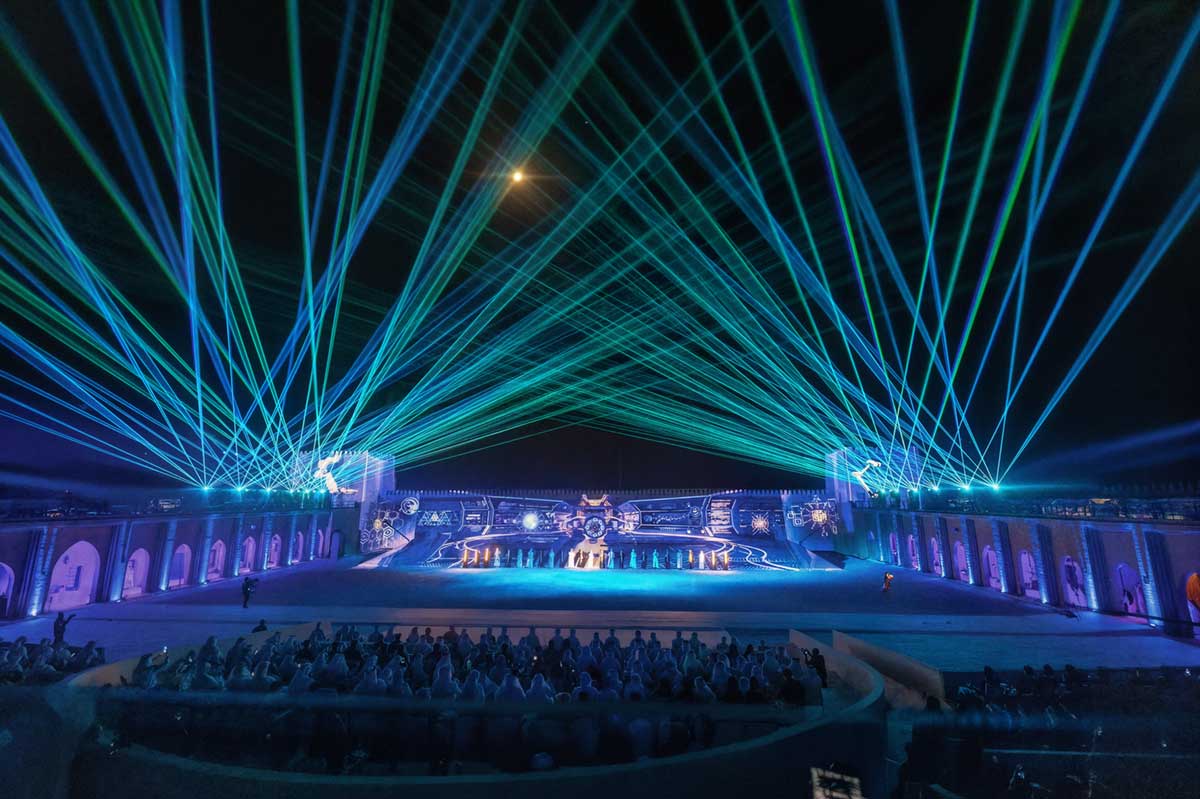
A recent project in which Artnovi played a key role was the UAE National Day celebration at Al Dhafra Fort, bringing together heritage, live performance and contemporary artistic storytelling. “The historic architecture, scenography, music, light, projection mapping, choreography, drones and technology all became parts of one story,” Maria explained, adding that the opportunity to engage more deeply with Emirati culture made the project particularly meaningful.
“We did not simply want to create a spectacular show,” she added. “We wanted to understand the story we were telling and find a contemporary artistic language that treated it with care while speaking to today’s audience.”
At Artnovi, artists, designers, engineers and developers work as one team. “We have worked together for many years. We handle creative development and the main scenographic production in-house, which allows us to preserve the integrity of the original vision at every stage of delivery,” Sergey emphasised. This combination of artistic and technical expertise enables Artnovi to create its own objects, mechanisms and interactive systems, developing solutions around the idea behind each project.
The UAE has become a particularly important base for the company. Beyond the scale of local projects, Sergey values the diversity of people and ideas around the studio. “Living and working in such an international environment has broadened our view of the world,” he reflected. “Encountering different cultures, traditions and ways of thinking naturally changes how you see the world and, over time, what you create.”
As interest in immersive experiences grows across the region, Maria offered her own definition of the term. “For me, immersion is about the depth of an experience,” she said. “A single powerful thought can be immersive. So can music, an image or any genuine emotion evoked by art. When a thought, image or feeling continues to live within you long after you have encountered a work, that is true immersion.”
The same philosophy informs the studio’s approach to new technologies. Artificial intelligence is rapidly changing creative processes, but Sergey sees it primarily as a practical tool rather than a substitute for human creativity. “AI has already become a natural part of our lives, and above all I see it as a very useful and powerful tool,” he stated. “I do not think we should be afraid of AI. We need to learn to use it well and understand where it can genuinely help.”
For Maria, openness to new tools is inseparable from the value of an individual artistic voice. “Having your own creative voice has become even more important,” she observed. “AI can help you find a form or realise an idea more quickly, but it cannot live your life for you. And that life is where your own artistic thinking comes from.”
For all the discussion of technology, the challenges Artnovi faces today remain largely human. When content can be created faster than ever, standing out requires more than impressive imagery. “It is becoming easier to impress someone for a few seconds, and harder to create something they will truly remember,” Maria commented, reflecting on how to preserve depth as the pace of work increases. “How do we become faster without becoming more superficial? How do we use new technologies without becoming dependent on them?”
For Sergey, maintaining quality also depends on how the team works under tight deadlines. “Sometimes the largest projects have surprisingly short preparation periods,” he said. “That is when a team that has worked together for many years becomes especially important.”
The Middle East is a key focus for Artnovi’s development. “There is a rare combination of scale, ambition and openness to new ideas here. We are particularly interested in projects that combine these opportunities with an attentiveness to cultural identity,” stated Maher Mohammed Al Shahaimi, Growth Director.
“We see great potential in working with heritage as a living part of the present and a foundation for the future. Artnovi’s role is to find a contemporary artistic language for these stories while preserving their meaning and their connection to place and people,” he continued. “These are the projects in which we aim to be a creative partner, helping to shape the vision from the outset.”
Europe also remains an important focus, particularly in theatre, opera, ballet and live performance. Maria sees opportunities to develop new scenographic ideas in collaboration with directors. “There is something unique about theatre: a living person and a real space, where the impossible can happen right in front of you,” she explained. “I want our work to stay with people. It does not necessarily have to exist physically for very long; sometimes a project lasts only a few minutes. But if, years later, someone still remembers an image, the music, the space or simply a feeling they experienced during one of our projects, that is one of our greatest achievements.”
“Time is the most valuable thing we have,” Sergey concluded. “If someone gives us a few minutes or hours of their life, I want us to give them an experience that stays with them for much longer.”
Photos: Artnovi