

With legions of fans in all corners of the planet, wherever in the world Metallica and their loyal crew find themselves, one thing is for certain: they always put on a show that delivers the very best version of themselves. “This show is all about the band,” stated Show Designer, Dan Braun. “I work for a band that’s not like anything that existed before. So, each show also has to be different from what existed before. The goal is always to create a platform where they can go out, connect with the audience, and be the best Metallica they can be. Nothing else matters…”
With the M72 World Tour entering its third year, TPiMEA caught up with the Metallica crew at the end of 2025 during the tour’s Middle East leg, which saw them follow up a stint in Australia and New Zealand with two Formula 1 shows in Qatar and Abu Dhabi respectively, either side of a one-off performance at Bahrain’s Beyon Al Dana Amphitheatre.
Welcoming TPiMEA backstage in Bahrain, longtime Metallica collaborator Braun and Production Manager, John Mulder, delved into some of the creative inspirations and technical achievements behind the M72 World Tour. “A Metallica show is half band, half audience,” Braun commented. “The band pushes energy into the crowd and the audience amplify that energy and throw it back to the band; it’s all about that transfer of energy between band and audience, and it’s my job to create an environment where that can happen in the most unencumbered way possible.”
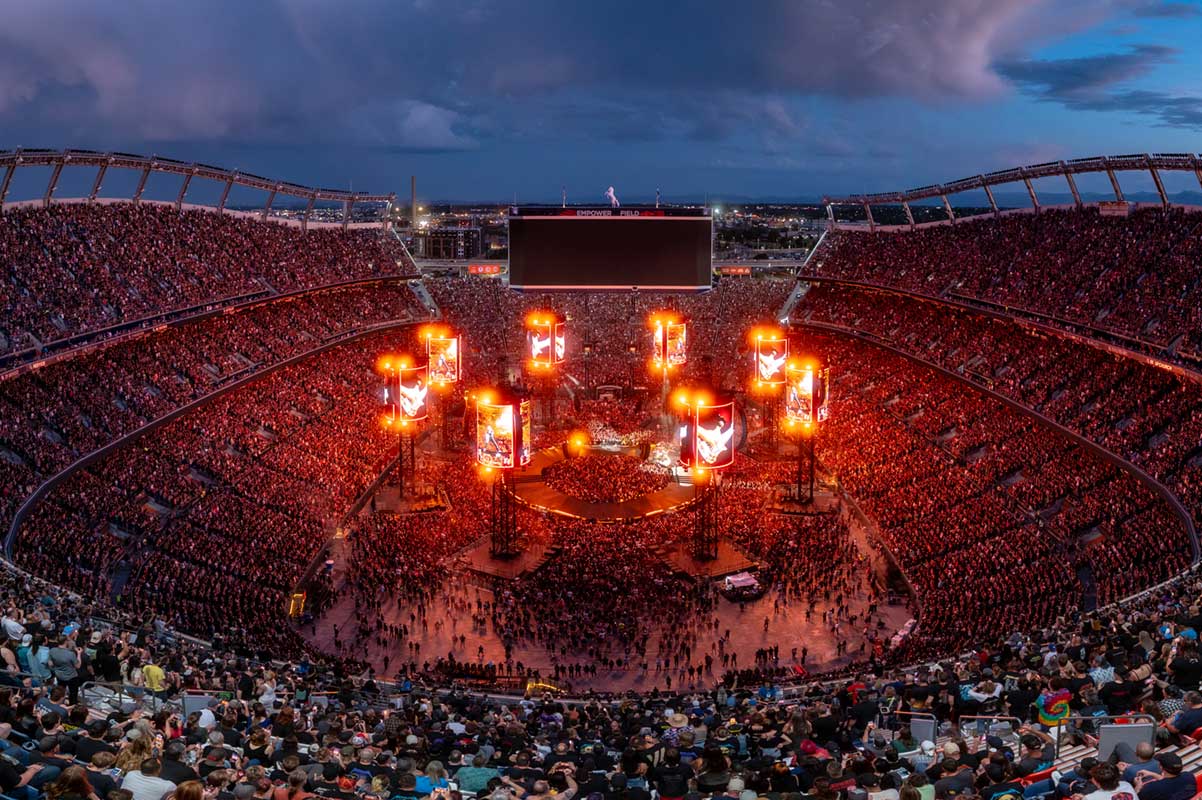
With this people-focussed approach placed front and centre of every design decision, Braun developed an in-the-round stage design that eschewed the old tropes often trotted out on rock and metal shows and instead aimed to create an intimate atmosphere in large-capacity stadiums. “The stage set was never going to be a giant haunted house or a Harley-Davidson,” he laughed. “Wherever you are in the stadium, the backdrop is always the crowd on the other side; the audience are just as much a part of the show as the band.”
Mulder chimed in: “The ultimate goal is for each fan, no matter where in the venue they are, to feel like Metallica is playing especially for them. That’s not easy when you’ve got up to 80,000 people like we have in some of the stadiums we’ve played on this tour, but Dan’s design is so effective in creating this feeling.”
A fan of the Bauhaus school of design, favouring minimalist architecture, Braun opted to go to a circle – “the simplest form in nature” – when creating the design, which features eight gigantic steel towers around a circular runway, enveloping the iconic Metallica Snake Pit, which allows a select few fans the opportunity to get a unique perspective on the show from inside the stage.
Conceived by Metallica’s Manager, Peter Mensch, Braun described the Snake Pit as “the single biggest transformation in staging since the Romans raised the Greek stage from the floor to a platform”. He added: “It has been copied by so many since Peter came up with it, and it’s something that we continue to embrace in our stage designs.”
The circular runway stage features four main playing positions where the band are “at their most powerful”. Braun commented: “When the four of them are together in those positions on stage, that’s the money shot. Playing in the round is the only way I can take the worst seat in the house and make it just as good as any other. I was the kid in the worst seat, so I want everyone who comes to our show to experience the full force of Metallica.”
This concept of democratising the audience experience was thrown into particularly sharp focus on both the Australia and New Zealand and Middle East shows, which were presented in an end stage format rather than the in-the-round stadium production. However, according to Mulder, “there’s no such thing as a B show when it comes to Metallica”. He commented: “I’ve seen a lot of acts in my life and very few have this ability to deliver no matter what. It’s very special to play a supporting role in it.”
Photos: Brett Murray and Jeff Yeager, Metallica