

Late changes, unclear ownership, and bespoke control setups are a familiar source of stress in live productions. As interaction becomes more central to event design, the way these systems are built matters more than ever.
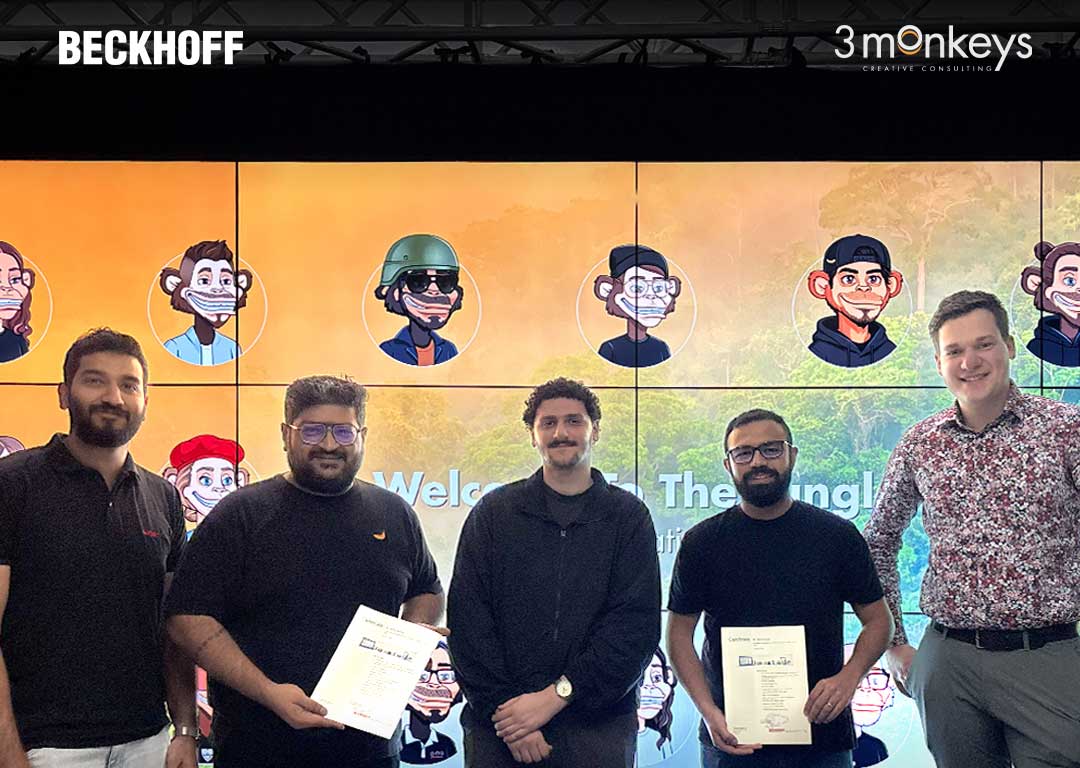
In this Q&A, 3 Monkeys’ Chief Technology Officer, Rudi Buchner, and Benjamin Bruns, Managing Director, Beckhoff Automation, reveal how a system-based approach is helping to protect both creative intent and delivery confidence in event production.
Why are custom interactive systems often so temperamental once deployed?
RB: Most custom interactive systems work fine in controlled conditions. That’s not the issue. The problems usually show up once the system leaves a lab, workshop, or demo setup and has to deal with the real world.
Many interactive systems are built as one‑off solutions. They grow out of individual requirements and clever fixes rather than a clearly defined system. Logic ends up spread across different platforms with unpredictable behavior based on assumptions.
As long as everything stays within expected conditions, that can work. Once those assumptions are challenged, the system becomes sensitive and harder to control.
Creativity isn’t the problem here. What’s often missing is a clear structure for how interaction is meant to behave when conditions aren’t ideal.
How has Three Monkeys approached this differently?
RB: We treat interaction as something that needs to behave reliably outside ideal conditions.
Instead of building a new control setup for every project, we’ve focused on creating a repeatable automation backbone. Physical inputs, logic, and outputs sit inside the same control environment as media servers and show control, rather than running as a separate layer next to the show.
That way, behaviour is defined upfront. When things change, as they always do, the system reacts in a predictable way instead of needing custom fixes.
What role does Beckhoff Automation play in this system approach?
BB: At its core, Beckhoff provides a real‑time control platform that connects physical systems and digital logic in a structured way utilising a standardised PC-based control architecture. It’s the only control system on the market which has built-in interfaces for the entertainment industry like DMX, sACN, PSN, Art-Net, QSC, Riedel and many more.
In event and experiential environments, this means signals from sensors, operator interfaces, and physical devices are processed centrally and made available in real time to systems like media servers, lighting, show control, or custom software. Control signals can also flow back and forth, between creative or operational systems and the automation layer to drive physical behaviour.
Bringing audio, video, lighting, and motion control into one deterministic, low-latency automation platform is exactly how complex installations stay reliable at scale. Furthermore, this structure reduces sensitivity to real‑world variations and makes systems easier to integrate, operate, and adapt over time.
What changes when interaction is treated as a unified system?
RB: Behaviour becomes more stable.
In many projects, physical systems are technically connected to the show but don’t really live inside it. Media, show control, and interaction run in parallel, with a lot of assumptions in between. Small changes can then have unexpected effects.
When interaction is part of a unified system, inputs are handled consistently and outputs behave in known ways. You still have flexibility, but it’s controlled flexibility. The system defines how it adapts instead of relying on last‑minute interpretation.
What does this mean for agencies and production teams?
RB: It removes a lot of uncertainty.
Teams spend less time compensating for fragile behaviour and more time focusing on the experience. Responsibilities are clearer. Changes are easier to assess. Technical decisions don’t need to be reopened every time something shifts.
It’s not about making projects more technical. It’s about making them easier to deliver with confidence.
What’s the bigger takeaway for the industry?
RB: Interactive experiences are becoming more central.
The question isn’t whether custom interaction can be built. That’s already proven. The question is whether the systems behind it are designed to behave reliably once they leave controlled environments.
Reliability isn’t a constraint on ambition. It’s what makes ambition workable at scale.
Photos: 3 Monkeys