

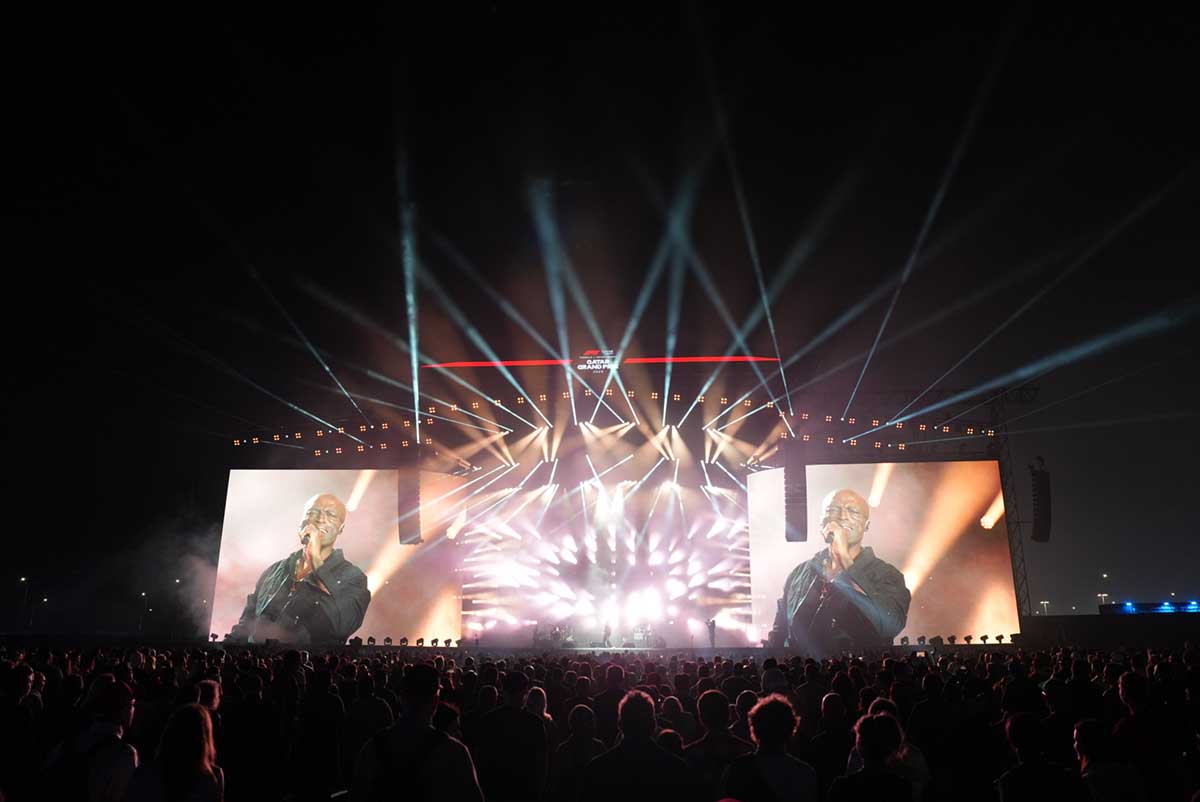
Since the 2022 FIFA World Cup, global attention has remained firmly fixed on Qatar’s emergence as a major sporting and entertainment destination. The Formula 1 Qatar Grand Prix is the latest showcase in that evolution, bringing an expanded live entertainment offering that saw the circuit transformed into a premier concert venue following the race. This year’s line-up included Seal, Cheb Khaled and Metallica, with Creative Technology Middle East (CTME) tasked with delivering the production infrastructure to support performances of this scale for an audience of over 30,000.
Building on previous editions, CTME supplied both the equipment and the expertise required to elevate production values and meet the demands of A-list touring artists, with a wide-ranging brief including a main stage, VIP hospitality areas, and four-sided LED delay towers.
“Our long-term relationship with Lusail International Circuit has really allowed us to deliver at the highest level,” Irum Ashraf, General Manager at Creative Technology Qatar informed TPiMEA. “We’ve seen a steady development of projects in Qatar, and this was no different – a fantastic set of concerts with a great line-up.”
The concerts demanded a complex production infrastructure, including 684 LED panels totalling more than 600 sq m of display surface, a distributed audio system featuring 28 line array speaker per side, and over 400 lighting fixtures controlled by a high-capacity network processing thousands of DMX channels simultaneously. “It’s a great circuit and a beautiful space – especially since the 2023 renovation – and we were tasked with building on that,” Ashraf added.
At the heart of the production was a robust Luminex network infrastructure. Twelve GigaCore 10 switches provided PoE to distributed devices, while GigaCore 26i and 30i switches handled the core routing. One of the biggest technical challenges was extending reliable internet connectivity across the entire concert footprint, with access points positioned to ensure consistent coverage.
“The big advantage was that we already knew the client’s requirements and understood the site,” said Darius Charlery, CTME’s Head of Integrated Networks and Communications. “Last year we covered the control rooms, but this time it was the entire track with network connectivity.”
Aesthetic considerations added another layer of complexity. “Everything had to be hidden,” Charlery explained. “Because our team knows the site so well, we were able to adapt quickly to last-minute changes.”
The scale of the concert operation pushed the network far beyond previous deployments. “Everywhere needed Wi-Fi, catering for a 500-strong production team,” he said. “We went in a month early to build sitewide internet coverage – from Artist Village to control room, stage, boneyard and catering. It was the biggest project my team executed in 2025. One for the books.”
Crew communications were handled via a Riedel Communications Artist matrix with SmartPanels and 20 Bolero wireless belt packs, supported by Hytera radios during pre-production.
‘The stage package had to work for any genre’
Lighting for the post-race concerts was significantly expanded this year, with a total of 392 moving lights deployed. Fixture choices were made with specific performance criteria in mind: Robe iFORTE units provided key light and beam effects, while Ayrton Kyalami fixtures delivered the punch needed to cut through ambient light. Twelve Robe RoboSpot systems allowed remote follow-spot operation.
“We produced a much larger lighting design this year, enhancing the existing architectural lighting and adding eye-candy to functional elements,” said Sam Connolly, Head of Lighting. “We had a dedicated team for the concerts, the same as last year, so the process was familiar and very smooth.”
Beyond the stage, 450 Cameo ZENIT W600 LED wash lights by Adam Hall Group illuminated the track buildings and pit lanes, while helipads, grey zones and the F1 Academy building were lit for helicopter shots. VIP platforms were accented with Astera LED Titan Tubes and Elation Professional KL PAR FC fixtures. Three four-sided lighting totems combined LED screens with ACME PIXEL LINE IP fixtures, alongside Elation PROTEUS EXCALIBUR and a Robe iBOLT for long-throw effects.
Lighting control was handled via three MA Lighting grandMA3 consoles, networked using sACN, with grandMA3 NPU XL processors providing additional horsepower and redundancy. The lighting network ran on a dedicated Art-Net and sACN structure, isolated but carried over the same Luminex fibre backbone. This approach enabled sitewide colour changes and effects from a single control point. “Depending on who won the race, we could change the entire site’s colour scheme to match the winning team,” Connolly explained.
CTME worked closely with Al Laith on stage design, overlaying the new layout onto the previous year’s footprint. Using Syncronorm Depence, the team produced detailed 3D renders and pre-visualisations. “At that stage, none of the artists were confirmed,” Connolly said. “The stage package had to work for any genre, from DJ to singer to full band.”
An LED concept proposed by Carlos Aguilar, Head of Video, saw the main screen coil across the stage, with Elation PROTEUS EXCALIBUR fixtures laid out in curved floor patterns. Ayrton Argo 6 units were positioned behind ROE Visual Vanish LED panels. “We really wanted to showcase lighting through the Vanish LED,” Connolly noted. “The Argo 6 was perfect – it could act as both beam and wash.”
Delay towers mirrored the stage lighting, ensuring audience members at the rear received the same visual experience. “We cloned the stage looks onto the delay towers,” Connolly recalled, crediting the work of the whole CTME Lighting team, which this year included Lighting Programmer, Warren Hutchison. “We used largely the same team as last year, which is a huge advantage,” he added. “The client knows exactly who they’re getting.”
‘It’s an impressive amount of equipment’
CT leaned into current festival trends by deploying large-scale IMAG to connect the audience with the stage. ROE Visual Vanish V8T LED was selected for the main canvas, allowing lighting to be integrated behind the screen. In total, 700 sq m of LED was installed on stage, with a further 800 sq m across four audience totems using 3.9 mm LED.
“The idea was to use Vanish more creatively,” said Aguilar. “We doubled the screen size and treated it as a massive canvas. Because you can put lighting behind it, you get layers rather than a flat image.”
Video processing was handled by Disguise media servers, with VX units delivering eight 4K outputs. “Using Pixel Hue meant we could receive 32 4K inputs,” Aguilar explained. “Everything was connected from day one, so when artists arrived, their content was ready.”
Live camera mixing was handled via a Ross Carbonite 4K 2ME switcher. Coverage included four Panasonic UC4000 broadcast cameras, two Panasonic AW-UE150 PTZs, six Marshall mini cameras, and an RC dolly camera running on a 45 m track in front of the stage. “It’s common at UK festivals but less so in this region,” Aguilar said of the camera setup. “With IMAG screens and VIP displays, it makes sense to capture the best possible footage.”
Reflecting on the delivery of 1,800 sq m of LED, he added: “It’s an impressive amount of equipment, and it takes serious expertise to make it show-ready in just two days.”
‘We converted a lot of sceptics’
CTME’s audio team, led by Head of Audio Tim Cook, took on the challenge of covering the 200m-wide outdoor site. “It was a typical rock ’n’ roll gig,” Cook laughed. “…Just a bit bigger than expected!”
A d&b audiotechnik PA was selected for the project, comprising 16 GSL per side, supported by 14 KSL outfills and 36 SL-SUBs across the front. Four KSL delay towers ensured coverage to the back of the audience. Control was via a DiGiCo Quantum 338 at FOH, with a DirectOut PRODIGY.MP acting as the central hub.
“At Metallica’s request, we used split sub-arrays left and right,” Cook explained. “But we aligned them in a way that minimised phase issues. Once [Metallica FOH Engineer] Greg Price arrived and listened, it was hugs all around.”
Seal’s FOH Engineer, also new to GSL, was similarly impressed. “We converted a lot of sceptics on this gig,” Cook said. “The touring teams were very accommodating from the start – they knew they were working with people who know what they were doing.
“It was a great team,” Cook concluded. “The load-in was quick, everything was thought through, and everyone was happy.”
The successful delivery of the 2025 Qatar Grand Prix post-race concerts further underlined both CTME’s growing footprint in the region and Qatar’s continued ascent as a global hub for major live events.
Looking back, Ashraf commented: “Qatar has really cemented itself as a destination for major corporate and sporting projects. We’ve recently delivered the FIFA Football Awards, alongside events such as Mobile World Congress and Web Summit. All of that brings the world’s eyes to Qatar.”
For CTME, the Grand Prix represented not just a technical challenge, but the culmination of years of collaboration, regional investment and local expertise. Delivering a complex, multidisciplinary production within the constraints of a live racetrack environment required detailed planning, trusted partnerships and an experienced on-the-ground team.
“I want to thank our client, Lusail International Circuit, for trusting us to bring their vision to life,” Ashraf concluded. “Racetracks are challenging environments for ambitious productions, particularly from an access and logistics perspective, but the CT team on the ground was fantastic. We received great feedback.”
Photos: CTME