

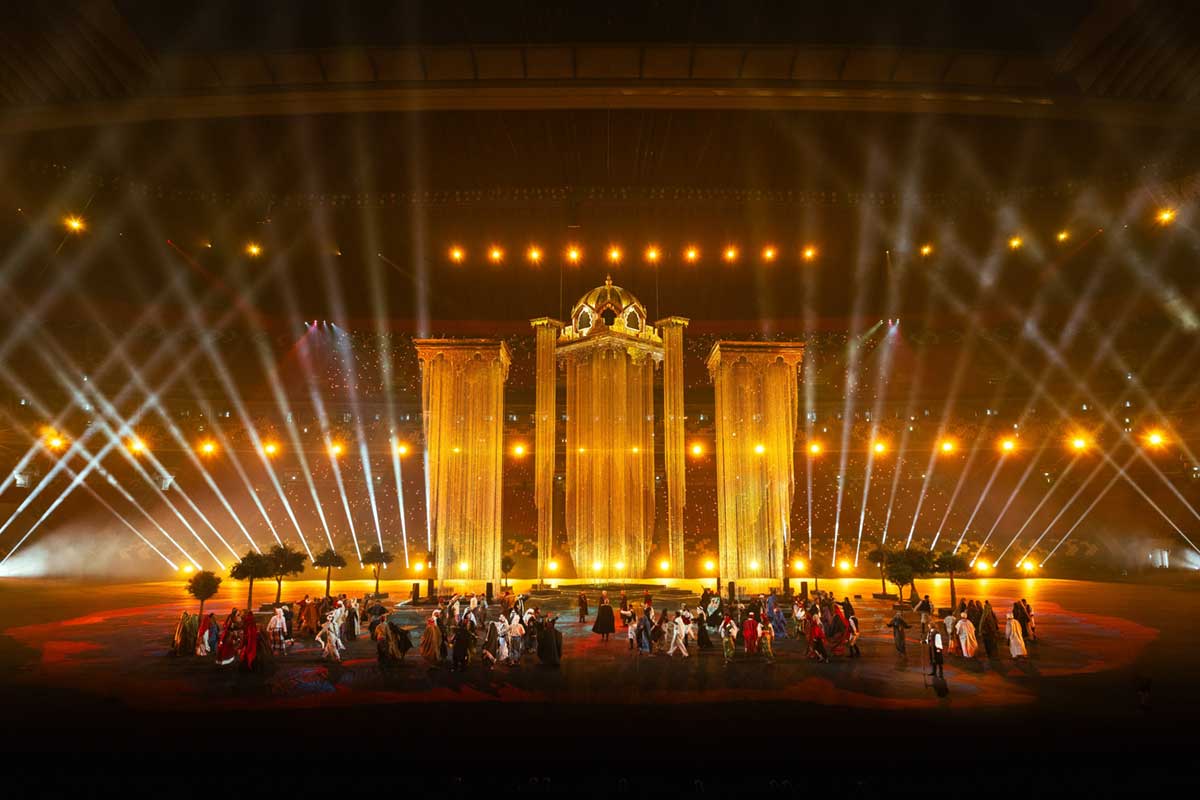
The FIFA Arab Cup 2025 kick-off in style at Qatar’s Al Bayt Stadium, with more than 60,000 spectators treated to a spectacular and visually ambitious Opening Ceremony ahead of the first match on 1 December, 2025. Katara Studios engaged SILA SVETA to develop the full creative concept for the stage design and visual content, while Roland Greil produced the lighting design and Auditoria delivered the full stadium audio design.
Inspired by ancient Arab legends, the 20-minute show explored the themes of unity, heritage and renewal through a narrative-driven cinematic experience that traced the creation, transformation and symbolic rebirth of the gigantic structure at the heart of the production – a 40m-tall inflatable golden dome surrounded by columns, which were gradually revealed as the elements rose into their full form.
Arthur Kond, Creative Director at SILA SVETA, explained how he and his team pinpointed two key ideas from Katara Studios’ initial brief in the early conceptual phase of the project: “First, the object had to feel truly monumental,” he recalled. “And second, it needed to be assembled and dismantled during the show.” With these parameters always in mind, Kond set about creating a structure that was not only lightweight and safe for the pitch but also could be dismantled within just 15 minutes, ensuring there was no delay to the start of the match.
The distinctive, almost fractal three-dimensional muqarnas commonly found in Arab architecture provided inspiration for the structure. “This shifted the idea away from a single object toward a larger architectural structure, closer to a temple or a city, built from columns inspired by traditional elements,” Kond explained. “This direction introduced a clear challenge: combining monumental scale with strict technical limitations. Finding the right balance became central to the stage design process.”
Further inspiration came from a detail in Gaudí’s Casa Batlló in Barcelona, where Japanese architect Kengo Kuma used chains as a structural decorative element to clad a staircase and unify vertical space. “This reference suggested a solution – using chains as the bodies of the rising columns for our monument,” Kond revealed. “This approach made it possible to bring the columns onto the field in a compact, folded state and visually convey the moment of the monument’s construction.”
As the columns rose, the chains – hidden within the platforms – gradually unfolded downward, creating a sense of what Kond described as “endless verticality”. He added: “It was important that the audience could not immediately perceive where this movement ended, giving the impression of an almost infinite structure”.
The resulting kinetic structure transformed into five levitating columns, with 22km of chrome-finished chain forming shimmering tails beneath them. The entire stage, produced by Stage One, was supported by truss systems, with 20 automation winches lifting and lowering scenic elements weighing around eight tonnes. Eleven steel-wire catenaries ran across the pitch to carry the load and divert the winch lines, while all scenic pieces were brought onto the field on custom platforms using 102 wheels to distribute weight and protect the playing surface.
The storyline and visuals were tightly integrated with the choreography, music, and projection mapping on the field, creating a seamless visual and emotional flow across the stadium. Roland Greil created the lighting design, with PixMob technology used to transform the audience into a synchronised field of light, while Creative Technology Middle East delivered a comprehensive projection solution including 48 Barco 40k projectors for the field of play and 16 Panasonic 35k projectors for the scenic, with Disguise media servers handling content.
The project continued SILA SVETA’s long-term collaboration with Katara Studios, which comprises several major sporting events in Qatar, including the FIFA World Cup Qatar 2022 Closing Ceremony and the 2023 AFC Asian Cup Opening Ceremony at Lusail Stadium.
“This project marks our sixth collaboration with Katara Studios and our third football ceremony in Qatar,” said Magrifa Güra, Producer at SILA SVETA. “This involved dozens of partners, industry specialists, and around 200 performers. Our previous experience in Qatar proved invaluable; knowing the venue and its technical limitations allowed us to develop ideas much faster and avoid unnecessary rounds of testing. Katara Studios – and Qatar as a host – continue to impress us with their level of preparation and their ability to bring together top professionals for live sports productions.”
‘A positive project from start to finish’
Auditoria supplied the full stadium audio design, completing its second delivery at Al Bayt Stadium following its deployment at the FIFA World Cup 2022 Opening Ceremony. While the creative brief was entirely new, the team’s experience at the venue and prior understanding of its unique architecture and structural limitations proved invaluable.
Unlike conventional stadiums, Al Bayt’s roof is formed from fabric, designed to evoke a traditional Bedouin tent. While visually striking, this conceals all roof steelwork, meaning no new rigging points can be introduced. As a result, the stadium’s existing house system had to be fully removed and replaced, with all new arrays flown from the original hanging locations and within the original weight loadings.
“The venue comes with a few technical constraints,” explained Scott Willsallen, Sound Designer at Auditoria. “We had a fixed number of hanging points, fixed weight capacities, and a very short timeline. The key was using those limits creatively rather than fighting them.”
Auditoria designed a system using L-Acoustics K2 throughout both the upper and lower seating bowls. Additional subwoofer arrays were introduced to extend low-frequency performance, creating a more even full-range experience across the stadium.
With rehearsals largely restricted to off-site locations to protect the playing surface, on-field access was limited. To maximise accuracy, the system was fully modelled using Soundvision and EASE, with live measurement points in the stadium used to calibrate predictions against real-world behaviour.
“The rehearsal window was tight, but that didn’t limit our ability to refine the system,” Willsallen stated. “Because everything was flown and installed early, we could tune and optimise outside of rehearsal time. That gave us the headroom we needed to really focus on intelligibility and musical clarity.”
Spoken word was used throughout the ceremony, meaning that speech intelligibility was just as critical as musical impact. The system was tuned to deliver clear spoken word across all 60,000 seats while preserving depth and energy in the musical score. Katara Studios supplied fully prepared music stems, allowing the team to mix dynamically on site.
“For a stadium of this scale, it sounded remarkably controlled,” added Willsallen. “The narration was clean, the music carried real weight, and the broadcast feed translated beautifully. The system gave the composers and director exactly what they needed to tell the story.”
The system was supplied and integrated by Clair Global, and it remained in place following the Opening Ceremony to support fixtures throughout the tournament.
Auditoria worked closely with the Katara Studios production and technical teams, including: Executive Producer and Head of Production, Mahmoud Hamaky; Executive Creative Director, Ahmed Al Baker; Technical Director, Adrian Burke; and Systems Technical Manager, Greg Kershaw.
“None of the restrictions became obstacles,” Willsallen reflected. “Everyone involved understands this environment inside out. That shared experience makes a huge difference and is what contributed to making this a very positive project from start to finish.”
Photos: SILA SVETA