
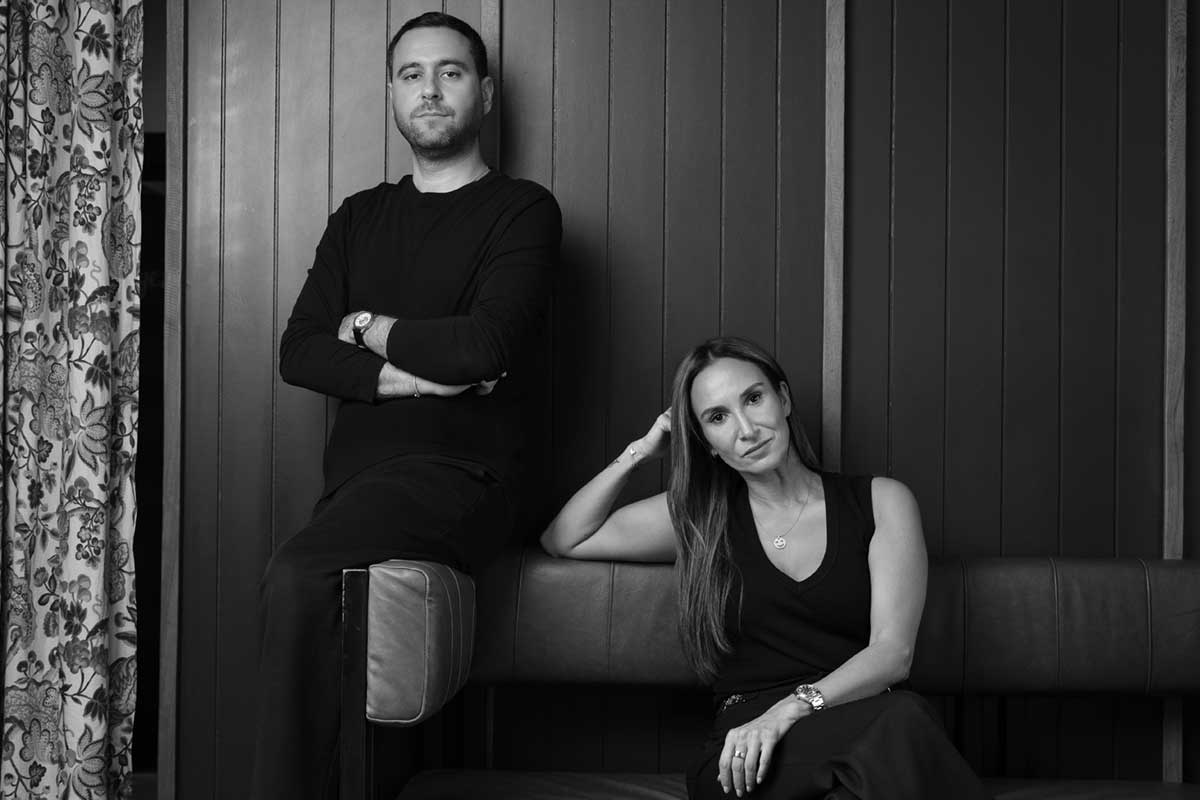
Like many great companies, M:E Entertainment started as a result of its co-founders’ personal frustration. “We both spent years travelling to experience the kind of electronic music events that weren’t available at home at that scale,” began Karim Matter, explaining how he and fellow co-founder Sarvie Etebarian became inspired to launch M:E Entertainment. “When we’d come back to Lagos and talk about it with friends, the conversation kept circling back to the same question: why do we have to leave?”
Nigeria has always had the culture, the crowd and the energy required to host successful live events. However, the co-founders spotted a gap at the top end of the market. “There are already collectives here doing serious work; DJs with real followings, sold-out events, a rave scene that predates us by years – we didn’t come in to start something from scratch,” Etebarian stated. “The specific gap we saw was access to the very top tier of international acts in the house and electronic scene; the A-list headliners that Nigerians were spending thousands of dollars travelling abroad to see. We just wanted to make that experience available here, at the production scale it deserved.”
The co-founder come from quite different backgrounds, with Etebarian moving across tech, real estate, and business development, while Matter bring direct experience in the live entertainment and hospitality space, having founded and contributed to several notable venues and events in Lagos. “One of us is always thinking about the vision and the business case, while the other is thinking about execution and relationships, and we both do both things,” Matter revealed.
The company has already made a splash on the Lagos live events scene, organising Rampa Lagos in March 2025, which attracted over 2,000 attendees, followed by welcoming Grammy Award-winning DJ Black Coffee to Lagos in April 2026. “Rampa was a genuine risk, and we knew it,” Etebarian recalled. “Lagos had been selling out electronic music events long before we came along, and the rave culture here is deep and established. The unknowns were on our end: could we execute at the scale and standard we were promising? Would an artist of that profile feel comfortable coming? Would the production hold up? It sold out, and it answered those questions, for us and for the wider DJ and booking circuit. Burna Boy and Olamide showing up that night wasn’t something we engineered; it just happened because the room was right.”
Black Coffee Lagos, in partnership with DAPO, built on this success in a different way. “We had a full night of amazing talent like Caiiro, Da Capo, and Enoo Napa doing a B3B coupled with Massuma, Shoba, Remixia, Addy Edgal alongside Black Coffee. People flew in from the UK, South Africa and elsewhere,” Etebarian added. “When that starts happening, when Lagos is the destination rather than the place people are flying out of, you know something has shifted in how the city is being perceived on the global circuit.”
‘Technical production is everything’
When it comes to technical production, the M:E Entertainment team leave no stone unturned. “Technical production is everything,” Matter stated. “The entire argument we’re making is that Lagos can deliver an experience that feels like what you’d find in Ibiza or at a major European festival. If the sound is off, if the staging doesn’t hold up, that argument falls apart immediately. The audience here is informed; they know what world-class looks and sounds like. They’ll notice if you’re not meeting it. We’ve invested heavily in production precisely because we don’t want anyone – the artists or the crowd – to feel like they’re getting a version of something rather than the thing itself.”
While West Africa has historically been a difficult place to execute major technical productions, Matter believes this is changing. “There are real infrastructure challenges – logistics, power, sourcing the right equipment – but every event that executes well raises the floor for what’s possible,” he commented. “What we’ve also found is that when you commit clearly to international standards and communicate that to production partners and artists from the start, people rise to meet it. The talent and the desire have always been here. What’s been growing is the investment and the belief that it’s worth doing at that level – and that belief is now being backed by evidence.”
Chief among those operational challenges is power. “Anyone who hasn’t worked here underestimates the challenge of event power until they’re in it,” Matter stated. “You’re essentially building your own infrastructure for every event.” Equipment logistics and sourcing the right technical crew are also not a given. “This can take significantly longer and cost more than it would in a market with established supply chains for this kind of production. Timelines must be much longer because there’s less room for things to go wrong close to the date,” Matter explained, noting that the biggest challenge, however, is often perception. “Convincing international acts and their teams that Lagos is a safe, professional, well-organised destination requires work upfront. Once they’ve visited, that conversation becomes much easier. Every event that delivers well is part of building that track record.”
According to Etebarian, “consistency, and more companies willing to invest at this level” are what is required for Lagos to truly make its mark on the world stage. “The culture and the crowd have never been the problem,” she added. “What’s been missing is a sustained track record of large-scale productions executing well, and the coordination between promoters to build a calendar that the global circuit can plan around. Artists and their management make decisions based on reliable data; ticket sales, production quality, and how smoothly shows run. Every event that delivers builds that case. We’re trying to contribute to it, but we’re clear that it’s bigger than any one company.”
The co-founders are taking a deliberately considered approach when it comes to programming. “We intentionally don’t do events every month,” Etebarian noted. “Part of what makes a city a destination is that sense of occasion; when something only happens once or twice a year, people plan around it – they book flights, they talk about it in advance. We want M:E events to be in people’s calendars before the lineup is even announced; that’s the culture we’re trying to build around what we do.”
Mattar added that every event that brings international attendees adds to the case for Lagos as a destination in its own right. “The goal is for artists and their teams to start factoring Lagos into their touring decisions the way they factor in other major cities,” he stated. “That doesn’t happen overnight, but it happens through consistency and through events that people genuinely remember.”
Looking ahead, the duo plan on building towards bigger events at larger venues with higher capacities. “When that happens, we want the lineups to reflect the full breadth of the scene – local and continental artists like the ones we’ve already been platforming alongside the international headliners,” Etebarian shared.
“The ultimate ambition is to bring world-class live experiences to Nigeria across genres and formats – whatever people are currently travelling abroad to see,” Mattar concluded. “We’re being deliberate about the pace; we’d rather build something that lasts and means something than scale quickly and lose what makes it worth doing.”
Photos: M:E Entertainment