

Once the preserve of cinema and studio settings, spatial audio is becoming increasingly popular in the world of live events. Known to many as immersive, object-based or three-dimensional audio, the principle of spatial audio in live events dictates that each individual sound – whether it’s a voice, a traditional instrument, or something generated electronically – is treated as a distinct sound object, with the flexibility to position it in space not just according to its physical origin but also creatively within a 360° auditory landscape.
“Spatial audio transforms our approach to sound design, allowing for a level of creativity and narrative depth previously unattainable,” commented Head of Audio for Creative Technology Middle East (CTME), Wissam Shaheen, explaining how the approach harks back to the era before electronic sound amplification, echoing the days when the placement and source of sound naturally guided the audience’s attention. “Imagine a 19th-Century orchestra where the solo of the first violin or the entry of the brass section commanded immediate focus, facilitating a form of storytelling that directed listeners’ attention precisely where it needed to be,” he posed.
“At the heart of this approach is a return to the fundamental ways our brain perceives and analyses sound,” he continued. “This shift transcends traditional mono and stereo setups, ensuring that every seat in the venue offers an optimal listening experience. Effectively, every spot is the sweet spot. This evolution in live sound amplification not only enhances clarity and immersion but also democratises the auditory experience, ensuring that every listener, regardless of their location, is fully engaged in the event’s narrative.”
As early adopters of spatial audio technologies, including d&b audiotechnik Soundscape and L-Acoustics L-ISA, CTME is well-equipped to meet the growing demand for spatial audio. However, according to Shaheen, the challenge isn’t just in adopting these technologies; it’s in educating content creators, producers, artists, engineers and audiences about their capabilities and advantages. “Our aim is to demystify how these systems can significantly improve the quality and immersion of live events, ensuring all stakeholders recognise the substantial value they bring to any production,” he commented.
As audience expectations rise, Shaheen anticipates a trend towards more personalised audio experiences, where individual listeners can choose how they experience the sound at a live event – either in a venue or even virtually. “Advancements in spatial audio technology will likely lead to more sophisticated integration with other elements of live events, such as augmented and virtual reality,” he predicted. “We’re committed to ongoing partnerships with leading audio technology companies. This enables us to have early access to new products and systems that can be integrated into our productions, offering our clients the most advanced solutions available.”
‘This was something very special’
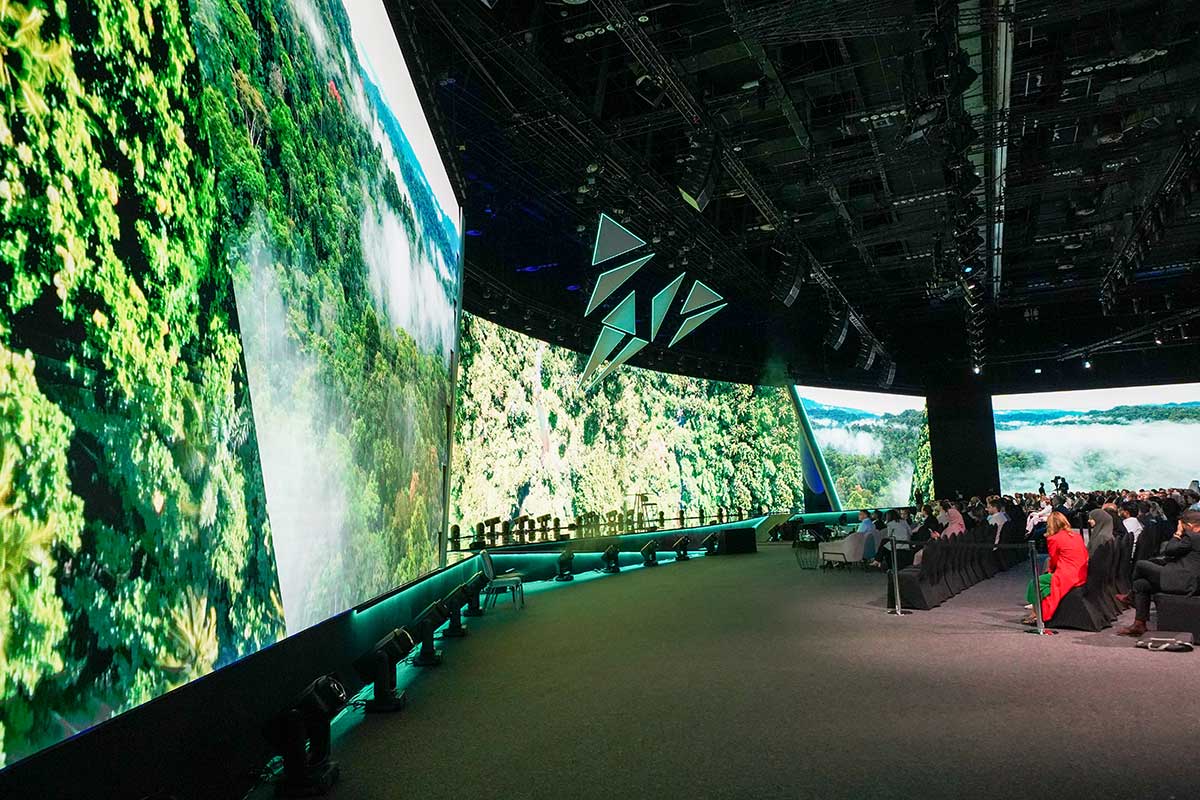
A recent notable example of spatial audio being utilised to its full potential is CTME’s delivery of the G42 Supercharged 2025 forum. Tasked by client Supercollider with delivering a full technical package including audio, video, lighting, integrated networking and comms, CTME promptly delivered the largest d&b Soundscape system deployed in the Middle East to date.
“This was something very special,” Shaheen beamed. “Usually, I am the one pushing to use spatial audio, but in this case the client asked for Soundscape. They were very involved in the process, and they knew exactly what they wanted, which was a breath of fresh air.”
Six hangs of ArrayProccessed XSL8 and XSL12 loudspeakers covered the 180° field, 15 Y-Series point sources handled the surround to complete the 360°, and nine 44S added front fill. The system was all grounded by an eight-strong array of SL-SUB for low-end extension, with amplification coming courtesy of D80 and D40 amps.
For control, a DiGiCo Quantum 338 with SD-Rack and SD-Mini Rack was set up on an Optocore loop, while 64 inputs were fed into a d&b DS100 Signal Engine running En-Scene and En-Space software. DirectOut PRODIGY.MP was utilised for conversion, routing and redundancy management, with QLab running playback. The audio team also ran d&b’s new streamlined standalone show control for Soundscape, Create.Control.
The audio team built a scaled-down version of the setup at CTME HQ in Dubai and underwent a thorough preproduction phase to ensure that nothing was left to chance on site. “We did three days of preproduction where we loaded all the content and had the whole team run through the show multiple times, reprogramming and dialling in to make it better and better,” Shaheen revealed. “Once we got on site, we had the whole thing ready within 48 hours, which is not easy for a show of this size and complexity.”
The audio content was composed and designed specifically for this system and the geometry of the room. “The storytelling read clearly and felt vividly real,” the Head of Audio revealed. “The system was so high resolution that we were in effect dealing with 29.1 surround sound, which gave pinpoint accuracy in terms of object placement.”
For any content that hadn’t been recorded in spatial, Shaheen recalled how his team utilised UpMix Plugin, which has the ability to convert most standard stereo tracks into Dolby Atmos 7.1. “This discovery is very important, because it means that even on gigs that haven’t had bespoke content built, we can still deploy spatial audio,” he stated.
As the Sound System Designer, Shaheen was also quick to credit his team, System Engineer, Tim Cook; and Playback Engineer, Georges Abi Aad; as well as external contributors, Soundscape Programmer, Aaron Holloway-Nahum of Southby London; Sound Designer, Luke Hatfield of AudioVille; and founder and Technical Director of Reactor Group, Jim Pollard – “the man who dreamed up the Soundscape upgrade and pushed hard for it, and also the show’s TD”.
‘A dream to work with’
As if the region’s largest Soundscape system wasn’t enough, the G42 event also featured an impressive lighting design by LD, Justin Adams. Almost 600 fixtures were deployed in all, including Ayrton Cobra, Rivale and Diablo and a Robe follow spot package, with the system built by CTME’s lighting team on an MA backbone and programmed by Adams on an Avolites console.
CTME Head of Lighting, Sam Connolly, explained how the lighting design was built around the triangular shape of the G42 logo. “The set included a giant scenic triangle made by Unusual Rigging, which comprised several pieces that moved independently via a Kinesis system,” he revealed. “Inside these triangles, we had DMX-controlled LED tape, which was probably the most complicated part of the installation.”
With a short load-in time, fixtures were prepped and dressed in the CTME warehouse before the team arrived on site. “Time was tight, but we got all our top in-house engineers on the project, and their high level of skill and experience meant the load-in went smoothly,” Connolly recalled.
On the video front, the setup featured a massive deployment of Absen 2.5mm LED, including a 42m by 7m main screen and 14m by 7m side screens, with content handled by Disguise VX 4+ media servers and a 4K Panasonic UC4000 camera system deployed to capture IMAG content.
“The technology on show from all departments was incredible,” stated CTME Head of Video, Carlos Aguilar. “Everybody went to a lot of effort to ensure that this looked nothing like a standard corporate gig.”
Aguilar was particularly pleased with the co-operation with the client. “The Supercollider team were a dream to work with,” he commented. “They put so much trust in us to deliver their vision, and we were delighted to be able to live up to their expectations.”
For comms, the team deployed Riedel Communications Matrix intercom systems, wireless communication units, 60 two-way radios for crew coordination, and Wi-Fi distribution.
Reflecting on the project, CTME, Managing Director, Andy Reardon, commented: “The G42 Supercharged Forum truly showcased what can be achieved when vision, creativity, and flawless execution come together. On behalf of Creative Technology, I’d like to extend a huge thank you to our client, Supercollider, for trusting us to deliver on such an ambitious brief. A special thanks also to Jim Pollard, Technical Director and Founding Director of Reactor Group, whose expertise and collaboration were invaluable throughout. This project is a real testament to the power of partnership and the outstanding talent across all teams involved.”
Photos: CTME