

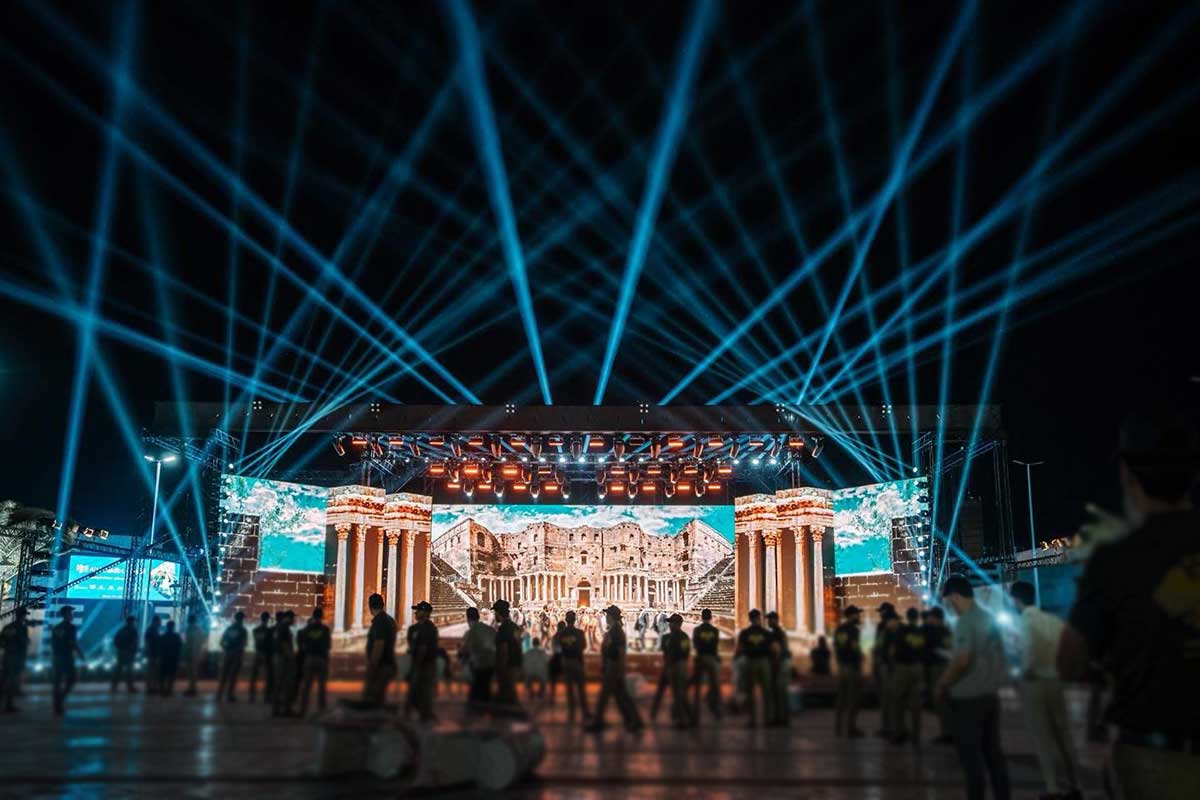
First held in 1954, the Damascus International Fair is one of the world’s oldest trade exhibitions, boasting a rich history of welcoming visitors from all corners of the globe. After more than 14 years of interruption due to the war, the Syrian Exhibitions and International Markets Foundation relaunched the Fair, with the 62nd edition taking place from 27 August to 5 September 2025.
With the Syrian events industry still working its way back full strength, Dubai-headquartered production house Artevor was tasked with bringing to life a grand Opening Ceremony that lived up to the historic occasion, and the company turned to experienced live events professional and Syrian national, Bashar Dardari, to lead the project delivery team.
“Given the scale of the challenge and the lack of local systems, teams, and expertise to deliver an event of this magnitude to an international standard, as a Syrian national with extensive international experience in large-scale productions, I was invited to join the project,” he explained. “It was a privilege to help bring back such an iconic cultural and trade landmark for Syria after more than 14 years.”
With only one week to prepare, Dardari took on a dual role as both Project Manager and Stage Manager. “This combined responsibility allowed me to connect the overall planning with real-time backstage execution, ensuring that nothing was lost between concept and delivery,” he told TPiMEA. “My focus was on creating a clear, efficient plan that avoided unnecessary complexity.”
A man of many hats, Dardari’s charges ranged from coordinating suppliers and assigning responsibilities to overseeing rehearsals and managing backstage operations during show night. “With around 70 performers appearing on stage, we established a full backstage area with dressing rooms and support facilities, which I supervised directly alongside one senior colleague and four local assistants,” he recalled. “This dual involvement meant I could maintain a consistent flow from the early build stages right through to the live performance, guaranteeing precision and smooth delivery.”
The Opening Ceremony took place in the large outdoor square of the Damascus International Fair, with more than 80,000 people attending on the night. “Managing such a vast audience in an open-air setting brought its own challenges, but it also created an unforgettable atmosphere that could not have been achieved indoors.”
The artistic programme on stage was created and directed by Inana Dance Theater Company, founded in 1990 by choreographer Jihad Mufleh. “Inana is one of the leading dance theatre companies in Syria and the Arab world, known for combining Arab history, culture, and folklore with contemporary performance,” Dardari explained. “Their work was central to the creative success of the Opening Ceremony and complemented the technical production beautifully.”
All technical equipment for the project was supplied by Artevor, with the company deploying its inventory from both Riyadh and Dubai for the project. “Artevor provided the complete package – including logistics, transport of equipment from both cities to Damascus, and full technical support,” Dardari reported. “Impressively, all equipment arrived a full day ahead of schedule, reflecting the company’s reliability and sense of responsibility.”
The show was built on a robust rigging system using TT, ST and FD trusses, along with Eurotruss structures for both stage and overhead support. Absen PL V2 3.9mm LED was the video display product of choice, with a combination of flat and curved sections displaying content produced by Artevor. There was also an extensive lighting rig, with a selection of Ayrton and Robe fixtures as well as Cyclops Lighting beams and strobes, and a selection of profiles and fresnels, all controlled via MA Lighting grandMA3.
Artevor also supplied the six core senior technicians who Dardari described as “the backbone” of the technical team onsite. “In addition, we worked with a small but effective support crew in Damascus, including four local PR staff, one runner, and one driver,” he added. “To execute the onsite build, we also coordinated with around 12 local labourers per day. The overall delivery was overseen by Radwan Zarki of Artevor, whose leadership and commitment were instrumental to the project’s success.”
Despite the project initially feeling “almost impossible” Dardari was delighted with the eventual outcome. “Within just one week, we delivered a full-scale international production under extremely difficult conditions – on time, without errors, and to a world-class standard,” he reflected.
“Being part of reviving such an important cultural and trade landmark was an unforgettable professional milestone for me. What I am most proud of is the spirit of collaboration and resilience shown by the entire team,” he concluded. “After more than a decade without this event, witnessing the audience’s reaction and the energy inside the venue was unforgettable. It proved that, even under the toughest circumstances, teamwork and determination can achieve something truly remarkable.”
Photos: Artevor