

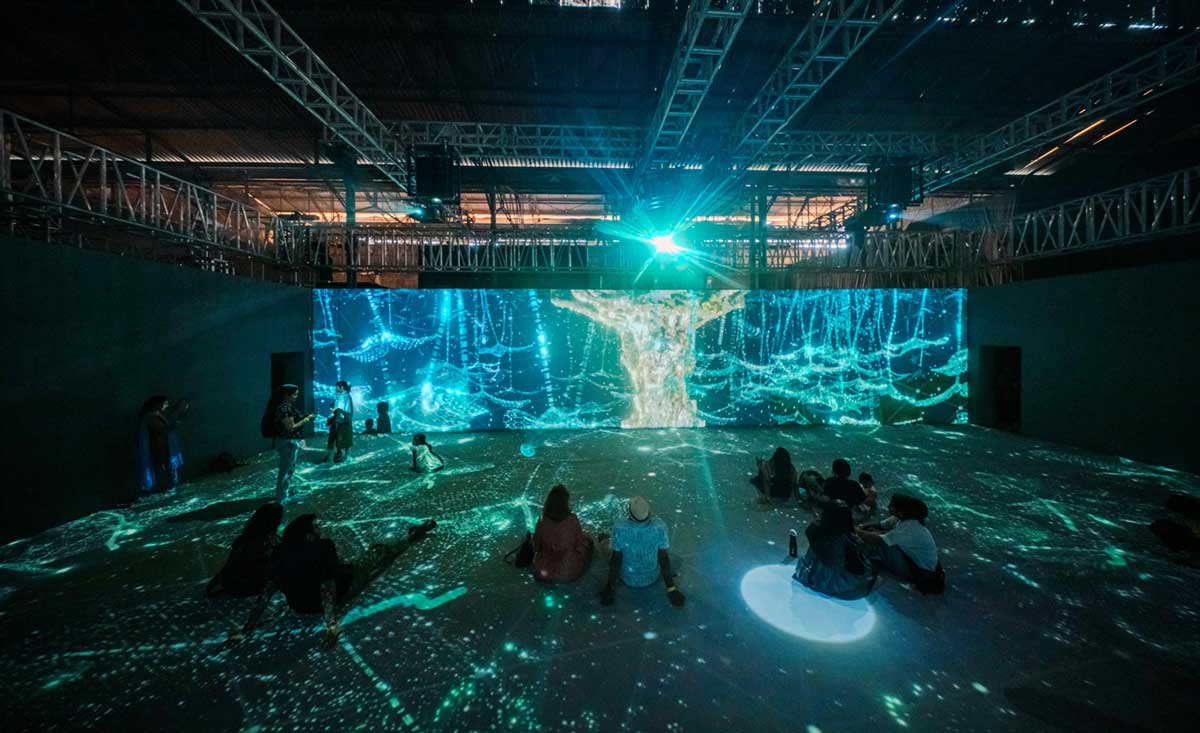
Spanning more than 200,000 sq ft of industrial space at Bengaluru’s trendy Alembic City art district, The Sixth Sense Festival brought together digital art, spatial audio, interactive environments and live performances.
Organisers Swordfish engaged Synergy Technologies to deliver a range of large-scale projection mapping installations across three flagship zones: the Immersive Room, the Silo and the Live Performance Arena.
Synergy Technologies’ Founder, Chirag Patel, described the collaboration as an opportunity to help realise an ambitious creative vision. “Swordfish are true visionaries,” he commented. “Their ideas were bold, genre-bending and uncompromising in scale. India has not witnessed anything of this magnitude in immersive art before. For us, it was about enabling a cultural milestone that could redefine how world-class immersive experiences are perceived and produced.”
Planning for the project began months in advance, with Synergy working closely with organisers and artists to define technical requirements. However, the full deployment of systems was completed within a 72-hour window, requiring careful coordination and redundancy planning. Equipment, including additional projectors, bespoke lenses, media servers and signal distribution systems, was transported from Mumbai to Bengaluru to ensure resilience on site.
Across all three zones, Synergy standardised on laser projection technology from Christie Digital Systems, selecting different models based on the specific demands of each environment. “Every space demanded its own philosophy of projection,” Patel explained. “Brightness, pixel density, throw distance, ambient light and architectural geometry all dictated different solutions. Our job was to balance artistic intention with optical physics.”
In the Immersive Room, a 2,500 sq ft enclosed environment, the team deployed 14 Christie DWU2400-JS laser projectors from the Jazz Series, each delivering 23,750 lumens. The system created full-surface projection across walls and floor, supported by customised optics to maintain consistent brightness and geometry. With only around 12 ft of ceiling clearance, ultra-short throw lenses were used for floor projection, while additional customised lenses ensured accurate mapping across irregular wall surfaces.
The installation was driven by Dataton WATCHOUT 7 media servers, with signal distribution handled via Lightware HDMI20-OPTJ-Tx/Rx90 fibre extenders to maintain low latency and signal integrity.
“Within the Immersive Room, clarity, vividness and uniformity were paramount,” said Patel. “The customised ultra-short throw lenses were a game-changer, allowing us to maintain geometry without compromising resolution. When you’re projecting across every surface, even microseconds matter.”
The Silo installation presented a different set of challenges, with projection mapped onto a curved exterior façade surrounded by trees and natural obstructions. With access limited to the front of the structure, projectors were positioned through narrow gaps, requiring precise alignment.
For this environment, Synergy deployed six Christie D20WU-HS laser projectors alongside a Christie Griffyn 4K50-RGB pure laser projector, delivering up to 50,000 lumens. All units were fitted with specialised lenses to maintain sharpness and colour accuracy across the curved surface, with Resolume Arena media servers managing the mapping workflow.
“The curvature of the structure meant we had to account for geometric distortion across multiple axes,” Patel noted. “The Griffyn 4K50-RGB gave us the brightness and colour volume needed for outdoor projection, allowing us to create a layered visual narrative that transformed the building.”
In the Live Performance Arena, projection formed part of a 180° visual environment incorporating stage backdrops, side walls and a transparent mesh screen positioned between performers and the audience. This enabled a dual-layer projection effect, including holographic-style visuals integrated into live shows.
The setup used four Christie DWU23-HS laser projectors with BoldColor+ technology, each delivering 23,650 lumens. One unit was dedicated to the mesh screen, with others covering the stage and surrounding surfaces. “Performance environments demand reliability above all,” Patel said. “The holographic mesh required exact brightness calibration – too little and the illusion fails; too much and the transparency collapses.”
Despite tight timelines, environmental constraints and complex signal requirements, Synergy maintained consistent delivery across all zones. “This project tested human endurance as much as technical expertise,” Patel reflected. “Delivering a flawless experience under such pressure reflects the discipline and cohesion of our team.”
Beyond the technical execution, the festival also aimed to support the development of India’s immersive technology ecosystem, including hosting TouchDesigner sessions in collaboration with The NODE Institute. “We want to be associated with initiatives that build ecosystems, not just events,” Patel concluded. “The Sixth Sense was not just a spectacle; it was a statement that our industry is ready to lead.”
Photos: Synergy Technologies