

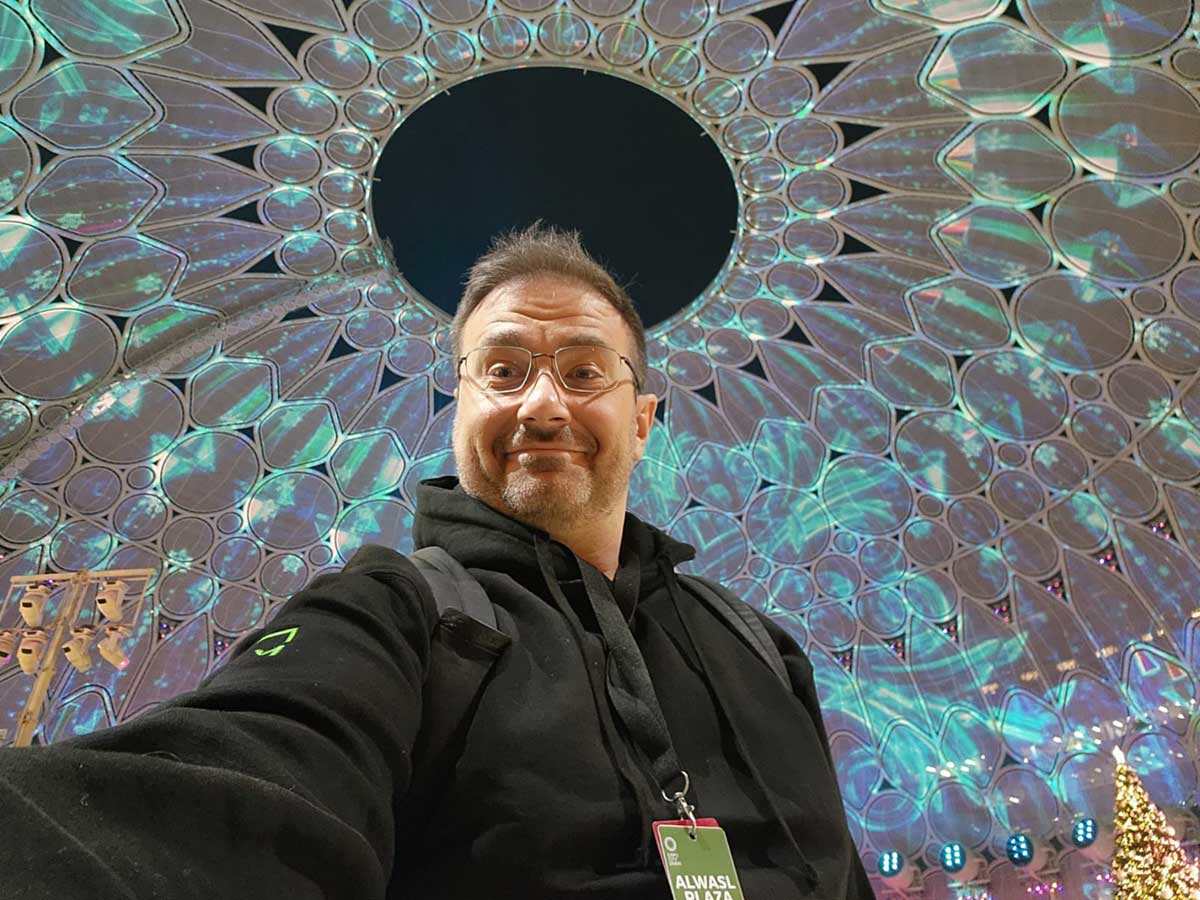
Anyone who has spent time backstage in the Middle East knows that the energy can get incredibly chaotic, incredibly fast. For Stefano Milan, Founder of CasaMilan, establishing complete control the moment he steps into a venue starts long before the first cue is even muttered. “My number-one rule is simple: claim your territory,” Milan opened, emphasising the importance of spatial discipline backstage. “You cannot afford to be the person fighting for a corner of a flight case five minutes before doors open. Your workspace is your cockpit – if it’s cramped, your show will feel cramped.”
To mitigate this, Milan makes it a point to ask the vital logistical questions long before ever arriving on-site. “I need to know exactly where I am sitting,” he explained. “You have to actively request your dedicated table, chair, power extensions, and relay screens for camera feeds or timecode. Secure that real estate early so you can focus entirely on the execution of the show, not the furniture.”
Once the physical workspace is locked down, the cuesheet becomes a showcaller’s primary weapon. However, building a document that actually holds up under real-world pressure requires a refined approach to design and collaboration. “If your crew needs a magnifying glass to read your cues, you’ve already lost the battle,” Milan laughed. “A great cue sheet isn’t an essay; it’s a highly visual roadmap. It needs to be clean, and the font must be entirely legible – absolutely no size six text!”
In a fast-moving production ecosystem, version control and accessibility can make or break a backstage workflow. Milan is a big advocate of leveraging modern digital sharing, utilising platforms like Google Sheets for the crew and client so everyone retains a live link to the working documents. “This sheet is, of course, protected so that I am the only one who is able to edit, while all others are viewers,” he specified.
“Naturally, the cue sheet is also saved and shared with the crew and client via email, WhatsApp, and as a physical printout. But for the love of production, we also need to stop using filenames like ‘Final_Final_v2’. It breeds unnecessary confusion. Stick to a strict, clear versioning system like V01, V02, or V06. Whether your team prefers digital or physical copies, get it to them early and lock it in with a solid, uninterrupted Cue-to-Cue rehearsal.”
Turning down the noise
Comms traffic can get notoriously messy, especially on complex, multiagency gigs in the region. According to Milan, maintaining strict vocal discipline across comms is paramount to keeping a production on track. “Silence is golden, but clear comms are platinum,” he stated. “A show completely lives or dies by the rhythm of the headset. Before you even whisper the first ‘Standby’, you have to lay down the comms ground rules.”
To prevent cross-talk and confusion during critical moments, Milan cross-checks his calling plan against the crew’s channel access to ensure everyone hears exactly what they need to hear – and absolutely nothing they don’t. “Establish that distinct vocal rhythm early in the day to avoid that dreaded ‘Who said that?’ chaos mid-show,” he advised.
The old industry phrase of ‘It’ll be alright on the night’ It is a philosophy that Milan vehemently rejects. “Absolutely not!” he countered. “True professionalism in this business is built entirely on what I call the 5Rs: Rehearse, rehearse, rehearse, rehearse, and rehearse again.”
To enforce this standard, Milan has trained his team to strongly advise their clients to respect three core practices onsite to avoid disappointment during the show: detailed speaker briefs to give even the most seasoned pros a quick mic and stage reminder; rigorous tech checks to physically verify every single signal and battery life before talent steps on stage; and content lockdown before going live. “Last minute surprise content only comes with high risk,” Milan warned. “If a piece of content hasn’t been checked, verified, and rehearsed, we ensure the client is fully aware of the risks involved with going live and of potentially jeopardising their event.”
When it comes to the equipment required to navigate a modern production, Milan recommends a blend of modern tech and traditional kit. “Digital is fantastic for overall efficiency, but analogue is your only true fail-safe,” he stated. “You need a setup that actively supports your workflow.”
On the digital side, adding an additional monitor can be “a total game-changer” for keeping scripts and show timers visible simultaneously. “Then you have your comfort and safety essentials – your hat, hoodie, chargers, cables, and your standard PPE gear,” Milan noted. “Never, ever forget what I call the ‘Old Gold’: a clipboard, a pen, and paper. When the local power flickers or your laptop decides it’s time for an automatic update, you will be incredibly glad you have that hard copy sitting right in front of you.
“To anyone heading out on-site in the region over the next few weeks: Tanta merda!”
Photos: CasaMilan
www.casamilan.co