

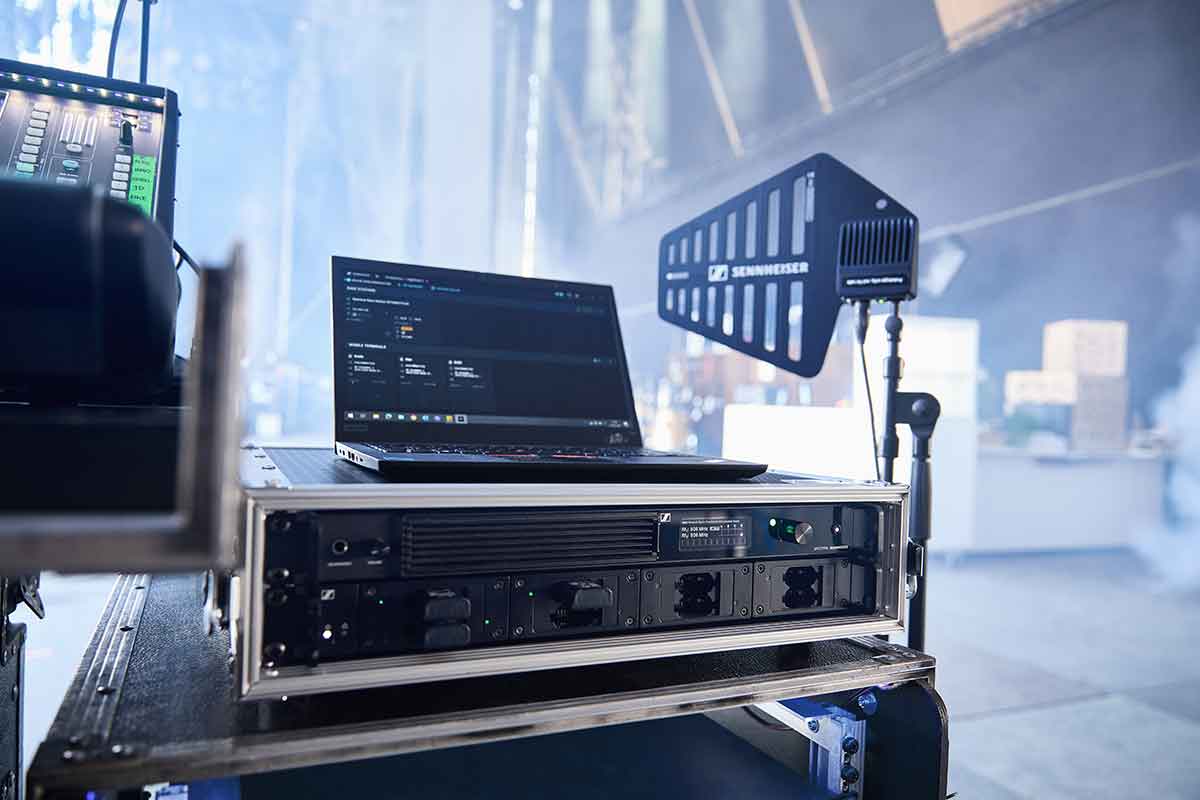
What is Spectera and what industry need does it address?
Spectera is the world’s first bidirectional wideband solution. Using the ground-breaking WMAS (Wireless Multichannel Audio Systems) technology, Spectera greatly reduces wireless system complexity, while at the same time considerably increasing capability, enabling time-saving workflows and offering full remote control and monitoring, including permanent spectrum sensing.
The wideband solution will be ideal for large productions, whether in the touring, broadcasting, or theatre fields, or in any other area that requires multichannel audio setups.
Spectera satisfies customers’ needs – ease of use, operational reliability and flexibility. It offers less hardware, drastically reduced frequency coordination, redundancy, and the flexibility of an ecosystem that grows with the users’ needs.
What are the main features?
Spectera features bidirectional bodypacks that manage both digital IEM/IFB and mic/line signals at the same time. The solution is remarkably resistant to RF fading and allows for flexible use of the wideband RF channel – for example, for digital IEMs with a latency down to a spectacular 0.7 milliseconds.
It represents a total shift in control and monitoring. It doesn’t just offer a back channel, but continuous two-way communication throughout, for truly complete remote control. Via the permanent control data stream, audio settings can be adjusted, IEM and mic levels adapted, RF health and battery status monitored, and much more. AES 256 encryption (AES 256 CTR Mode with >10kYears expiry) for both audio and control data ensures the necessary data privacy.
Also, all units help in continuously sensing the spectrum, meaning they scan for potential interference from other RF sources. With Spectera, it is possible for the first time to see ‘behind’ the RF channel that is being used and detect interference.
Bidirectional digital wideband transmission addresses many of the typical challenges that users, operators and owners of wireless audio systems experience today. These challenges include overly complex frequency coordination and complicated rack cabling for high channel counts, and the large footprint that a multichannel wireless system still has – in the warehouse, on tour and backstage, both for space and the amount of time required for load-in, load-out and setup.
One of the biggest innovations in the Spectera ecosystem is the Base Station, which, in a single rack unit with up to 32 inputs and 32 outputs, replaces a rack-full of wireless mic receivers and IEM transmitters. An entire production could be accommodated in a single wideband RF channel (6 or 8 MHz). The lower footprint continues to the bodypacks, which handle mic/line and IEM/IFB requirements simultaneously.
Having just one pack is not only a great asset for the talent, but it also makes the work of the sound engineer easier, who has just one type of pack and can, if required, quickly add an IEM to a mic. Warehousing also becomes much less complex, with just one Base Station and two frequency variants – UHF and 1G4 – for bodypacks and antennas.
What kind of R&D went into Spectera?
The research and development behind Spectera spanned over a decade, beginning in 2013, when engineers at Sennheiser proposed the idea of a bidirectional wideband solution. The project required extensive basic research on wideband algorithms and studies on wideband physics, followed by years of collaboration with frequency regulatory authorities across Europe, Asia, and the Americas to secure necessary changes in national frequency regulations.
Why is Spectera is particularly well suited for the Middle East market?
Spectera has several characteristics that make it ideal for the Middle East. The region has a high demand for wireless audio solutions in broadcasting entertainment, and corporate events, and Spectera’s wideband bidirectional system allows for efficient spectrum usage, reducing interference and maximising the available frequencies.
Spectera also offers scalability for large productions. With major venues like Expo in Dubai, international concerts, and important broadcasters with regional and international reach, Spectera’s ability to handle up to 64 channels in a single unit makes it ideal for complex audio setups.
Further, the Middle East’s climate can be challenging for wireless systems with high temperatures and humidity, and Spectera’s robust RF technology ensures stable performance, even in demanding environments.
The region also has specific regulatory challenges that can often make frequency coordination difficult. However, Spectera’s WMAS technology eliminates the hassle of manual frequency coordination, making it easier for professionals to deploy.
Finally, the Middle East is expanding its entertainment and media industry rapidly, with new venues, studios and production houses emerging all the time. Spectera’s cutting-edge wireless ecosystem aligns perfectly with the region’s demand for premium audio solutions.
Where can users in the Middle East get hold of Spectera?
Users across the region can connect with Sennheiser Middle East in Dubai: Building 6E, Block B, DAFZA. Tel: +9714 299 4004.
Photos: Sennheiser