
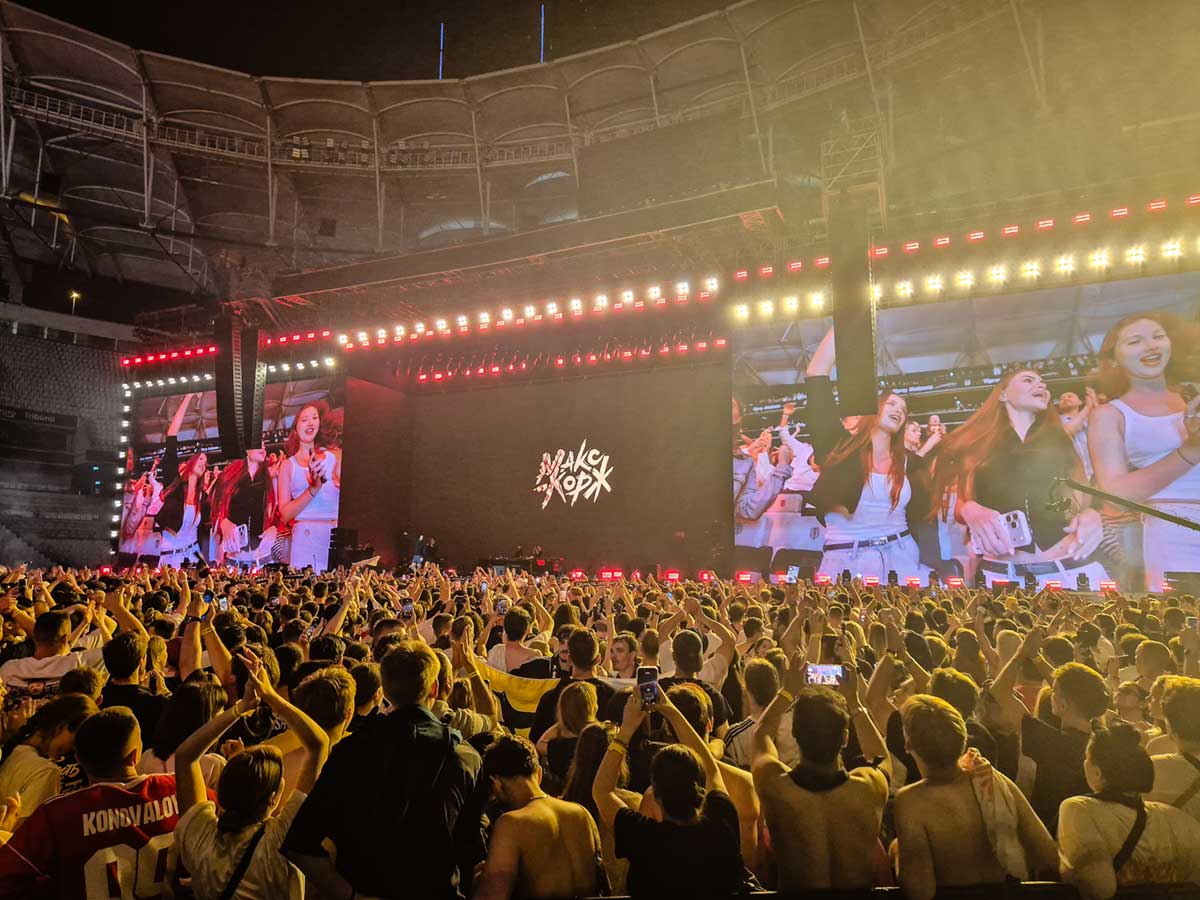
Wherever rap star Max Korzh goes, legions of loyal fans follow. This was no different in Istanbul as the artist played to a sold-out Beşiktaş Stadium, cheered on by a rapturous crowd singing along to every word of his extensive back catalogue. With such a devoted fanbase in tow, only the very best would do when it came to technical production and the artist entrusted JSA Stage Company with technical infrastructure, with Managing Director Alexander Strizhak taking the role of General Manager of Production, while Red Flame Creations, led by Sergiy Zhytnikov, handled the audio design and deployment.
“The technical execution and production scale of the event matched the highest international touring standards, driven by European engineering solutions and comprehensive on-site management,” began JSA’s Strizhak, whose role saw him successfully integrate all the technical departments as well as logistics and crowd safety into a single synchronised operational system.
While JSA has previously provided stage engineering and structural solutions for Max Korzh’s stadium shows in the likes of Latvia, Czech Republic and Estonia, the Istanbul project marked a significant evolution. “For this event, we assumed full responsibility for the entire turnkey production cycle of the technical department – from initial stage blueprints to live site management,” Strizhak stated.
The custom main stage was built using a proprietary modular concept developed by JSA Stage in 2023. “The configuration features seamless, full-stage LED screen integration and audio portal housing, designed to maximise visual impact while remaining adaptable to varying stadium layouts,” the GM of Technical Production explained. JSA also engineered a B stage in the centre of the floor, allowing the artist to appear directly within the crowd during key moments of the show to perform a special acoustic set.
Strizhak maintained an overview as local Turkish contractors erected the main stage, FOH towers, camera platforms, dedicated structures for lighting and pyrotechnics, as well as safety fences and crowd control barriers according to JSA Stage’s technical specifications. “Of course, there were some challenges during the concert preparations,” Strizhak recalled, noting that contractors were primarily hired by the promoter, and communication and processes between all production participants had to be properly managed.
“Istanbul has proven that our custom stage concepts and stadium management expertise allow us to deliver world-class production for artists of various levels anywhere in Europe, regardless of local infrastructure or regional specifics,” Strizhak commented. “We have created a scalable, highly efficient stadium blueprint. JSA Stage is fully open to collaborations for upcoming tours with both European and Russian-speaking artists, guaranteeing strict compliance with international production standards for complex shows.”
‘A dream system’
Ahead of the run, the Max Korzh camp was looking for a system designer with a track record of creating large-scale stadium sound… enter Sound System Designer, Sergiy Zhytnikov: an engineer with 27 years of experience in the industry, and 24 years with the L-Acoustics system, spending the past decade working exclusively with L-Acoustics. “Max is very involved in the production, and he is committed to making the show sound as good as possible,” he began. “Right from the first conversations, it was clear that I would be given the freedom to design the right system that the show needed, which was music to my ears. For me, it was a dream system.”
Zhytnikov’s first port of call when designing the system was to delve into the artist’s back catalogue. “I did some research into his music and his audience because ultimately we play for the people and they will be the ones who decide if it sounds good,” he stated. “We started with the ethos of ‘let’s not look at what people have done before’. We wanted to focus on what we can deliver to the audience and what best serves the content of the show.”
As well as being a natural showman, Max Korzh is known for his anti-war stance, and the rapper’s songs often carry strong messages of peace, which meant that clarity in the sound system was paramount to ensure that the lyrics were not lost behind the music. “People come to this show not just for the music but also to hear what Max has to say,” Zhytnikov explained. “He needs to be heard properly by the whole audience, no matter where they are in the stadium.”
With this in mind, the engineer designed a system he described as “balanced with a smooth transition from low end into the mid-range” and, of course, with “no holes” in the coverage. “The system needed to be punchy and powerful but also well balanced,” he noted.
For the Istanbul show, Zhytnikov specified a massive L-Acoustics system, which was supplied locally by Sens Music and Solid Technical Solutions. The system comprised a total of 104 K1, 92 K2, 84 KS28, 18 KARA II, six A15 and 133 LA12X amplifiers, all running over AVB network.
The system included main hangs of 14 K1 and four K2 with 12 flown KS28 subs; side hangs of 14 K1 and four K2, with rear hangs of eight K2 providing additional fill to extend the coverage on the side of the side array. “This is my first time using a rear hang like this,” Zhytnikov revealed. Normally we would overshoot a few top boxes to make sure there are no gaps on the side of the array system, but this rear-hang solution allowed us to have much more precision without wasting energy on the side hang.”
A total of 36 KS28 were ground stacked in groups of three spread across the width of the stage to provide low end, while six A15 served as centre fills, 12 KARA II provided in fill and a further six KARA II were used for outfill.
Four delay towers extended the coverage, with 12 K1 and six K2 as well as six KS28 (in cardioid combination) in each delay. There were also two delay outfills of six K2 to support the first ring of the delay towers and six ground stacks of four K2 each to support the B Stage. A Yamaha DM7 with Rio D2 was at FOH, while an Allen & Heath dLive with DM48 MixRack was used for monitors.
Processing was handled by DirectOut MAVEN.A, supplied locally by Radikal Electronik, which took 11 outputs, enabling the team to switch quickly between the main stage and B stage systems. “It’s a lifesaver,” Zhytnikov said of the technology. “That transition between systems has to happen so quickly and smoothly, I’m not sure it would have been possible without using DirectOut.”
Looking back on the project, the Sound System Designer was very pleased with the results. “We achieved a level where the clarity was exceptional, but you could still feel the punch of the system in the very back of the stadium. I’m delighted with where we ended up,” he commented. And while the tour rolled on to Düsseldorf next, which came with an even larger sound system, Zhytnikov is already looking ahead to a possible return to Istanbul. “Istanbul is a place where you can really express yourself creatively. I’m sure that we’ll be back next year, and I will see what I can improve.”
Photos: JSA Stage, Red Flame Creations