

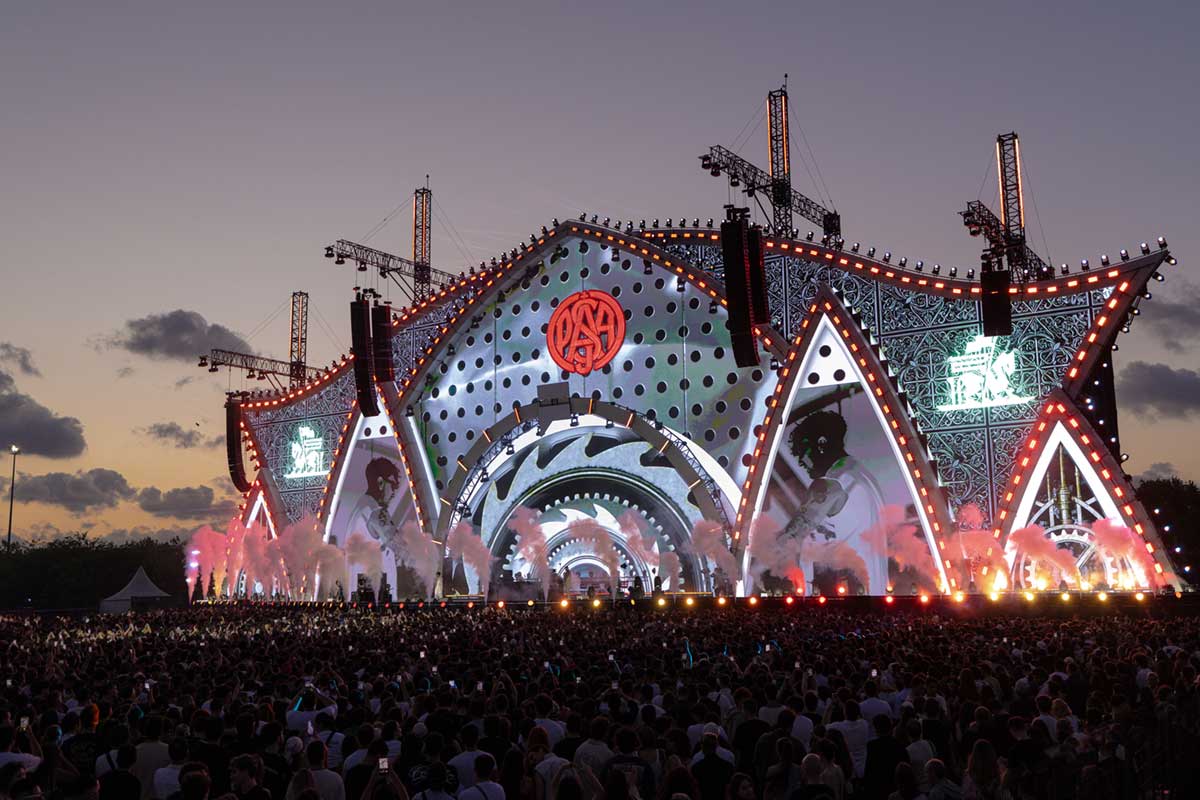
From Glastonbury’s iconic Pyramid Stage to the ancient monument-inspired Consciencia stage at Tomorrowland, some of the world’s best festival stages take their design cues from the great architecture of the past. This year’s Istanbul Festival also followed this trend, with the design for the main stage taking its inspirations from the geometric principles found in the work of legendary chief Ottoman architect and engineer of the 1500s, Mimar Sinan.
“We were particularly interested in how different spans, proportions and repeated forms come together to create a coherent architectural language,” explained İbrahim Kandemir, whose design studio was tasked with both stage design and production management. “We wanted to connect that approach with the energy of contemporary Istanbul and the festival’s diverse musical identity.”
Organised once again by Focus Istanbul, this year marked the fifth Istanbul Festival, with an eclectic lineup including the likes of Central Cee, Tiësto, ATEEZ and Argy joining Turkish stars including Gökhan Türkmen, Serdar Ortaç, as well as Edis and Gülşen in back-to-back performances over 16 days at the start of August.
To accommodate such a range of artists, Kandemir Design Studio developed a massive 70m by 28m stage. “At this scale, arch geometry is a powerful way to create a distinctive silhouette while framing the artist,” Kandemir explained. “Arches of different sizes draw the eye towards the centre and establish a rhythm across the stage façade. Their relationship determined both the overall appearance of the stage and the arrangement of its lighting and video layers.”
As well as the impressive scale of the stage, it was important that the design maintained a tangible connection to Istanbul. “We expressed that connection through proportion, balance, geometry and spatial impact. The result was a stage rooted in the city’s architectural heritage and expressed through contemporary live production technology,” Kandemir stated. “A festival stage needs its own identity, but it must also give different artists room to establish their visual worlds. The arches provided the stage’s consistent architectural character, while lighting and LED content allowed different atmospheres to emerge within it. At the heart of the design was the ambition to support both a strong festival identity and the artists’ creative freedom.”
Bringing both the design and production management responsibilities together allowed the Kandemir Design Studio team to stick closely to the original concept from ideation through to technical planning and on-site delivery. “We began with the overall silhouette and the audience’s relationship with the stage,” Kandemir recalled, discussing the design process. “Our key questions concerned how to frame the central performance area, how the geometry would read from different distances, and where the technical systems should sit within that composition.”
Stage drawings were produced in Vectorworks, with LED surfaces, lighting positions, PA locations, stage platforms and operational areas all considered alongside the main arch geometry. “We then developed the design into a technical drawing package covering plans, elevations, equipment layouts and detailed drawings, and that became the shared reference for the different teams working on the production,” Kandemir explained.
Syncronorm Depence was used for previsualisation, while MA Lighting grandMA3 consoles and Resolume were used for lighting and video programming respectively. “The geometry of the screens made it particularly important to prepare content for the correct surfaces in advance,” Kandemir recalled. “We shared technical drawings, MVR files and LED pixel maps with visiting artist teams, and we asked them to complete their content preparation and mapping before arriving on site. Previsualisation facilities and allocated programming sessions supported that process, allowing us to use the available on-site time for integration checks, testing and show-specific adjustments.”
Photos: Kandemir Design Studio