

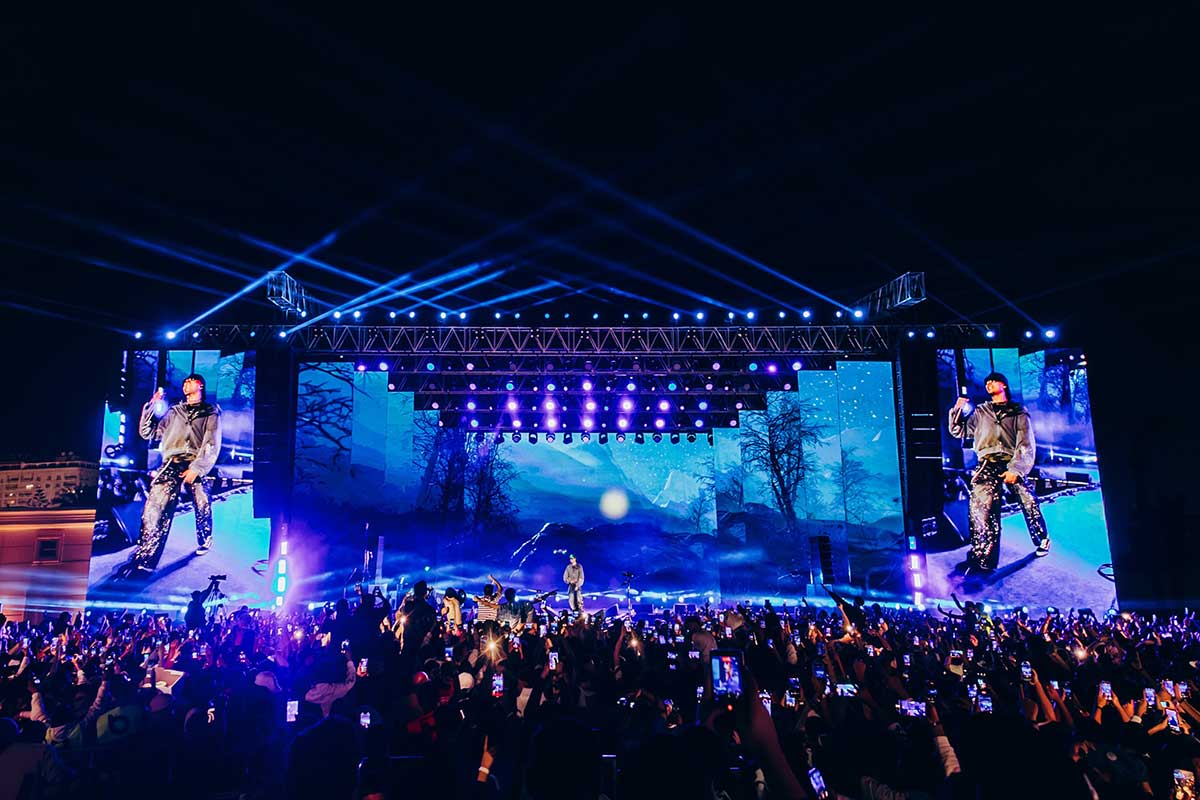
When artists return to perform in the place where they grew up, the show often brings with it an intangible added element of importance, with local fans eager to reconnect with their hometown hero. Yet, for Alexandria-born-and-bred Marwan Pablo, when he brought his distinctive blend of trap, rap and contemporary Arab music to Alexandria’s Antoniades Music Arena, according to Manager, Donia Gamila, it was very much business as usual. “Every show gets the same level of seriousness from us regardless of where it is,” she told TPiMEA. “That consistency is intentional.”
While the artist sets the tone and creative direction for his live shows, Gamila pointed to the “significant amount of trust” that is placed on the technical and creative teams to deliver on his vision. “Marwan continues to feed in throughout the process; it’s a fluid dynamic rather than a fixed handoff,” she explained. “The goal with every show is to create something seamless, where the technical execution is invisible and what the audience experiences is just the show. That standard doesn’t shift.”
Julien Yammine, founder of Fu Studios, played a key role in helping to realise the artist’s creative vision for the Alexandria show, delivering an “aggressive, high-impact visual language that reflects the artist’s style” in his lighting and screen design. “I wanted the design to have a strong sense of energy and attitude, while still giving us enough flexibility to build intensity throughout the show,” he stated.
The idea was to incorporate as many complementary lighting elements as possible, allowing a “powerful visual punch” to be delivered whenever the music called for it. “At the same time, the strong presence of LED screens throughout the stage played a major role in the overall design, creating a large visual canvas that worked hand in hand with the lighting and helped make the stage feel constantly alive,” Yammine explained.
The lighting rig was built around a combination of high-output fixtures, pixel sources and atmospheric effects, all working together to create what Yammine described as a “very dense and impactful” visual setup.
The rig consisted of 140 LED Top P4 LED strobes, 153 1m LED pixel bars with 18 10W sources, 69 Vello LED XP-800 moving washes, 66 LightSky F450 beams, 58 LightSky Superscopes, 24 flame jets, 16 audience LED blinders, 10 fog machines, 10 haze machines and two LightSky followspots.
“The LED strobes and pixel bars were used to create a strong graphic and rhythmic layer across the stage, while the moving washes and beam fixtures provided the main movement, aerial effects and punch,” Yammine described. “The Superscopes added another layer of high-intensity effects, particularly for moments where we wanted the stage to feel more aggressive and dynamic,” he added.
The LD was pleased with the combination of the large number of fixtures, the extensive LED screen presence and the atmospheric effects available to him. “Rather than relying on one type of fixture to carry the show, the idea was to have multiple lighting elements working together, giving us a lot of flexibility in how we responded to the different energy levels throughout the performance,” he explained.
Yammine was also happy with the use of LED pixel bars. “Having them integrated both along the stage floor and on the overhead trusses created a strong sense of continuity between the physical lighting rig and the screen content,” he described. “They also gave us a lot of flexibility in creating synchronised moments with the animations. We could use them to build subtle visual movement and then push them into much stronger, punchier lighting bumps when the music called for it. That combination of animation, pixel movement and high-intensity bursts created some of the visual moments I was happiest with on the show.”
Cairo-based Center Stage Lighting and Rigging was brought in as technical supplier for the project – an appointment that Yammine was onboard with from the start. “I’ve worked with their team numerous times on previous projects, and I have a very good relationship with them, which made the overall execution much smoother,” he reported. “Having an established level of trust and familiarity with the team was particularly valuable given the tight schedule and the scale of the setup.”
The tight timeline was exacerbated by the fact that all the equipment had to be trucked from Cairo to Alexandria before the installation could begin. “This meant that logistics, setup and programming all had to be handled within a very compressed timeframe, so coordination between everyone involved was extremely important,” Yammine stated.
Reflecting on the achievement, the LD thanked Artist Managers Ramez Moufid and Donia Gamil for their “constant trust” throughout the project. He also praised programmer and operator, Alex Douglas [recently named Lighting Designer of the Year at the TPiMEA Awards] as well as Rana for their “amazing execution and operation” of the lighting and visuals. “Their work was a huge part of bringing the design to life,” he added.
“Overall, I’m very pleased with how the project came together,” he concluded. “The biggest success for me was that we managed to achieve the feeling and energy we wanted to communicate to the audience through the combination of lighting, screens and visual elements. It was also a particularly meaningful show because it was Marwan Pablo’s homecoming. That added another layer to the experience, and I think the scale and intensity of the visual design helped make the moment feel as significant as it was.”