

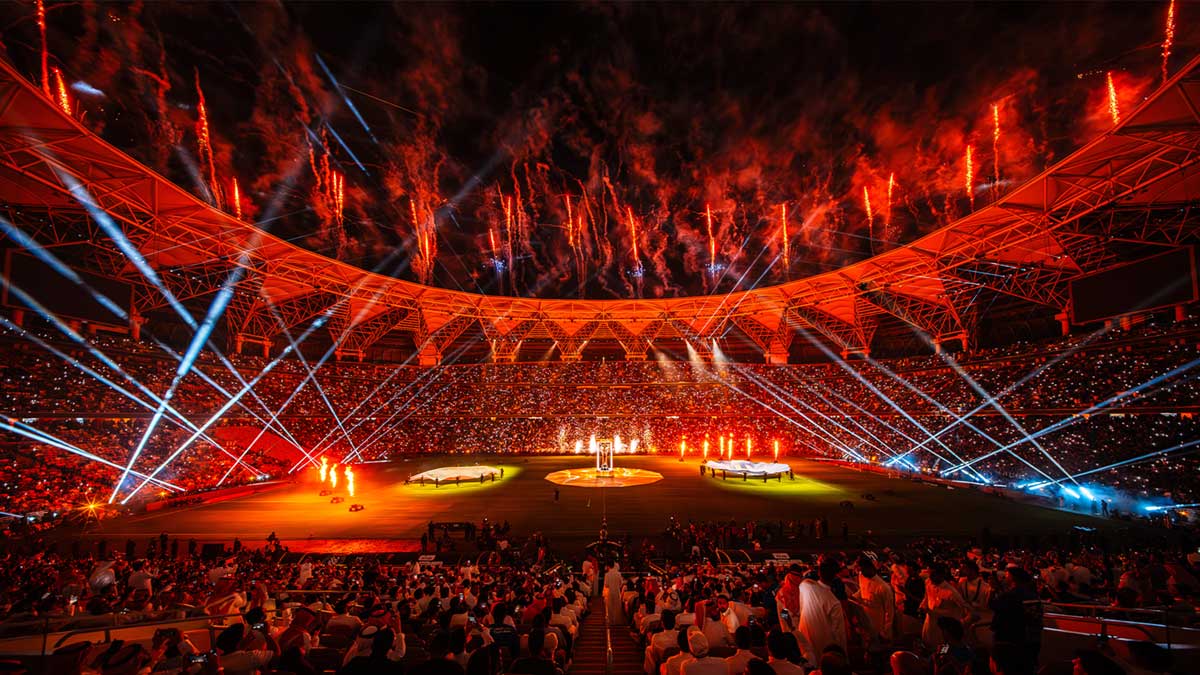
The 2026 King’s Cup Final was staged under the direction of the Ministry of Sport, the client and custodian of Saudi Arabian football’s flagship domestic knockout competition. Overseeing the ceremony on the Ministry’s behalf were Deputy Minister of Sport & Youth, Abdulaziz Almasaed; Project Director, Bader M. Almusleh; and Operations Manager, Ibrahim Almozan, who together set the ambition for a spectacle worthy of the occasion at Jeddah’s King Abdullah Sport City Stadium.
For the Ministry of Sport, the King’s Cup Final represented far more than a title decider. It was an opportunity to celebrate the game’s central place in Saudi national life and to showcase the Kingdom’s ambition as a home for world-class live events. The Ministry’s leadership set a clear brief: an occasion that felt unmistakably Saudi in identity while meeting the highest international standards of ceremonial production. That vision – rooted in prestige, heritage and national pride – shaped every creative decision that followed.
To realise that vision, the Ministry of Sport appointed Blink Experience as the agency responsible for delivering the ceremonial production. With a typically tight timeline to overcome, Blink assembled a team led by Executive Producer, Haya O Zakour, and Ceremonies Manager, Lamia Abdullayeva, working alongside Creative Director, Luca Taschini; Artistic Director, Giulia Marocchino; Choreographer, Tatiana Myrkou; Music Producer, ON THE SLY; video content creator, OCUBO; and many others.
‘A jewel among Saudi competitions’
In designing the concept for the ceremonial elements of this year’s King’s Cup Final, Creative Director Luca Taschini set out to turn the stadium into an Aladdin’s Cave of wonders, containing a precious jewel as a symbol of prestige, rarity and value. “The King’s Cup was conceived as the jewel among Saudi competitions, because of both its sporting importance and its direct connection to the Royal Family and Saudi football tradition,” he explained. “The jewel was never treated as decoration, rather as a visual and emotional language capable of expressing prestige, heritage, precision and ambition.”
The creative process began with a broad exploration around this year’s communication objectives and the symbolic value of the King’s Cup. “From the beginning, the intention was to balance an international ambition with a strong sense of Saudi identity and local culture,” Taschini stated, noting how every layer of the ceremony expanded on the jewel concept. “Jeddah became a jewel city within Saudi Arabia, the stadium a jewel of sports infrastructure, the two finalist clubs jewels of Saudi football, and ultimately the trophy was the crown jewel – the most desired prize in the national game.”
“We developed a unified visual system built around the symbolic language of the jewel. The geometry of the team banners, the trophy reveal and the video content were all shaped around its forms, reflections, tension and brilliance,” Taschini said. “The music followed the same direction, balancing restraint and intensity while incorporating elements rooted in local identity and tradition.”
Video content was central to defining the identity of the two finalists. “One of the key visual ideas was the confrontation between two iconic towers representing the clubs’ cities – the futuristic Kingdom Tower in Riyadh for Al Hilal and the more traditional tower of Al Rass for Al Kholood,” Taschini explained. “This contrast visually expressed two different histories and identities competing on the pitch.”
Befitting a fixture with a direct connection to the Royal Family, the occasion demanded flexibility until the very last moment to accommodate the presence of royalty. “We had to continuously adapt to different operational scenarios linked to the presence of HRH MBS,” Taschini revealed. “Events of this scale naturally require a high degree of flexibility until the very last moment.” Show Caller Charbel Karam played a key role in preserving the rhythm and integrity of the ceremony throughout these transitions.
‘An iconic piece within Saudi culture’
Progression was a strong theme of this year’s ceremony, with Taschini and Artistic Director Giulia Marocchino focusing on a rhythm that built into a crescendo as the show developed. “The show began in a restrained and atmospheric way before gradually building toward the act dedicated to football and the two finalist clubs, where the pace intensified to reflect the energy and dynamism of the game,” the Creative Director described.
This sense of progression was matched by ON THE SLY, which was entrusted with the music direction, composition and sound design. “The score opened in a minimal and atmospheric place before gradually opening up into something larger and more emotional around the reveal moments and climax sections, but still felt connected throughout,” described ON THE SLY’s David Wakefield. “We were also really pleased with the way the different musical influences, textures and emotional states all sat together within the same piece rather than feeling segmented.”
Saudi singer-songwriter Nourah Alammary, together with the client, served as an important collaborator when it came to the Saudi musical references and instrumentation running through the score. “We were using oud textures, daf drums and regional musical influences throughout, but always as part of the overall musical identity of the ceremony,” Wakefield revealed. “The inclusion of Fouq Ham Al Sohob carried a huge amount of emotional and symbolic weight. It’s such an iconic piece within Saudi culture, particularly around football and national occasions, so there was a responsibility to make sure it landed in the right way within the wider ceremony.”
Taschini was also pleased with the level of integration when it came to local culture. “That dimension helped the audience feel emotionally connected to the ceremony rather than simply spectators,” he stated. “For that, I’m very grateful for the creative input from Nourah Alammary and for the flexibility of the ON THE SLY team throughout the process.”
‘A strong sense of visual unity’
What pleased Taschini most was seeing the various scenic and creative elements ultimately work together in a balanced and coherent way throughout the ceremony. “Despite the escalation of the show, there was still a strong sense of visual unity,” he stated. “In this type of show, what ultimately matters is the audience’s emotional response. When all the elements align correctly, they create images that people do not simply watch but physically experience together as a collective moment.”
That collective moment was, above all, a celebration of the Ministry of Sport’s vision for the King’s Cup and its wider ambition for Saudi sport. By backing a production that placed national identity and heritage at its heart, the Ministry delivered a final that honoured the tournament’s prestige while affirming the Kingdom’s standing as a stage for world-class live events.
Taschini concluded by thanking the Ministry of Sport for its trust and the entire Blink Experience team for “creating such a strong and positive working environment” throughout the project. “Despite the challenges of producing a show of this scale within a very limited timeframe, the atmosphere always remained constructive and focused on achieving the best possible result,” he commented. “The final result was very much the outcome of that collective effort.”
Photos: Kraken Production Studio