
Where does the Hippotizer MEUSE MX fit into Green Hippo’s range of media servers?
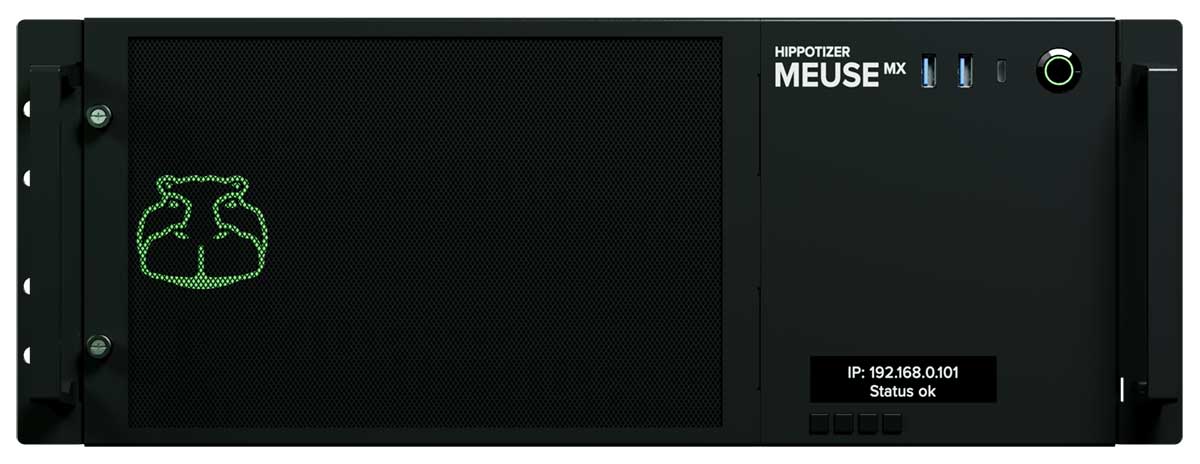
The MEUSE MX serves as the high-capacity anchor for the MX Series. From a technical standpoint, it sits at the top of the range for output density, pushing up to four 4K outputs from a single unit. This makes it the specific choice for high-resolution canvases where you need to drive a massive number of pixels without overcomplicating the rack.
While its sibling, the HYCO MX, is the series leader for raw processing and generative content power, the MEUSE is optimised as the primary output engine. The entire MX range is designed to scale with the project’s footprint, moving from the TEKA MX with a single 4K output, through the TAGUS and KASAI MX with dual 4K outputs, up to the four-output capability of the MEUSE and HYCO models.
What are the main features that will benefit end users?
From an operator’s perspective, the modular output architecture is a significant advantage. The ability to swap modules for HDMI 2.0, DP 1.4, or 12G-SDI means the server can fit into any system design, which eliminates the need for external converters and reduces potential points of failure in the signal chain. For professional environments where synchronisation is critical, the built-in Genlock ensures everything remains frame-accurate across multiple outputs and larger system arrays.
We are also seeing very high Notchmarks on these units, which is essential for running heavy real-time effects and generative content without dropping frames. Furthermore, the support for uncompressed playback ensures total visual fidelity, allowing the content to look exactly as the designers intended without compression artifacts.
Why is the MEUSE MX ideal for the needs of the Middle East market?
In a region where projects consistently outdo the one before, the MEUSE MX provides a practical solution to the challenge of massive system expansion. Through HippoNet, we can seamlessly cascade multiple units to act as a single, unified system, which is the only reliable way to manage the massive LED environments and immersive experiences common in this market.
A major feature for local workflows is the removable U.3 media slot. When dealing with the tight deadlines and massive file sizes typical of regional productions, being able to physically transport and deploy content without waiting for slow network transfers or re-encoding is a massive efficiency gain. It essentially removes the ‘waiting for progress bars’ bottleneck from the technical workflow.
Tell us about Extreme Productions’ recent purchase of the system… how important could this be for productions in the region?
Extreme Productions is a well-established player known for handling highly complex setups, so their move to the MEUSE MX is a significant validator for the series. By adding these units to their inventory, they are setting a new technical benchmark for what production houses in the region can deliver. This adoption is the perfect kick-off for the MX series in the Middle East, signalling a shift toward more robust, high-resolution workflows that can meet the increasing creative ambitions of regional events.
What kind of support does Procom Middle East offer to users?
At Procom Middle East, we provide technical support throughout the entire equipment lifecycle. This starts with pre-purchase consultation to ensure the server integrates perfectly with a client’s existing gear and specific project needs. We close the knowledge gap through specialised hands-on training, ensuring that when an operator is on-site, they are efficient and confident in the system’s capabilities.
Beyond the initial setup, we provide dedicated service, maintenance, and regular software updates to ensure the gear stays in peak condition. We also make it a priority to keep our users informed on the latest industry releases by scheduling regular demos, whether that is in-house at our facility or directly at the client’s own warehouse.
Photo: Procom Middle East